April 26, 2004

Carol's Pregnancy Session


Digital original
Since my first pregnancy images in 1989, I have been fascinated by the beauty of evolving motherhood; I have long hoped for the chance to work with a model throughout a pregnancy. When Carol called me to let me know she was pregnant, and would like to follow the pregnancy with images, I was ecstatic! What was even more fortuitous was that even though she was located in Halifax (just my luck, a chance to work with a model through a pregnancy happens after I move away) her pregnancy (due in the fall) coincided with the summer workshop season, during which time I will be visiting Halifax at least once a month to teach! So plans were laid, and roughly once a month for the next six months or so, I will be working with Carol, doing my best to document the ever changing beauty of a pregnant woman.
8"x10" film
What I hadn't expected was having the entire first session focus on the images we would be making in six months; every composition we made together was produced with a thought to how it would look with the pregnancy was in its final days. Usually, when I work with a model, I am very much in the present, viewing the images through the camera, and envisioning how the final print will look (Ansel Adams had a fancy word for this, "previsualization"), not thinking about how the pose will look on the model months from now.

April 12, 2004

Monique and Miranda by Candle Light

Digital original
After water nudes, candle images are the most requested style of my work by new models and Monique was no exception, specifically mentioning the first time we met to talk about working together that she'd like to work with candlelight. When she and Miranda came to Moncton, candle images were still on her list and, at the end of the models' last day in Moncton, Monique and Miranda spent more then an hour working with a single candle. I had tried candle nudes in the past with two models (both in Maine, and in Halifax) but never had as much success as I did with Miranda and Monique. I suspect a big part of this comes from concentrating on using one camera, as opposed to two, and also form more then five years of intervening experience.
Digital original
Usually, when I work with candles, I have the model lie on the floor and then move the candle around until the light looks best. With two models, I usually take the same approach, but in the middle of this session, I caught a glimpse of the candle between the models, and instantly stopped to look again. The candlelight had caught in Miranda's hair, and looked almost magical. I quickly changed the camera angle and pose until I could see through the viewfinder what had caught my eye - a very different and evocative image, compared to my earlier candle nudes.
Digital original
From that point, the session flowed between more traditional images, where the models worked around the candles, and more exploratory images, where the models were between me and the candle, and the light wrapped around their figures. The end of the session came as the poses became harder to find. It was only then that a tragedy was discovered - during the download of one of the cards, a mistake had occurred, and more then half the session's images were lost. This was heart-breaking, as I knew some of the images were very strong, but given the number of images I'd lost over the years in the darkroom, it was nothing new (accidents happen), and most of the engaging images (with the candle shining through Miranda's hair) were in the images that were saved, so all was not lost.

April 11, 2004

Miranda and Monique in Blind Light

When we'd purchased our Moncton home, I realized it would be a very different space to photograph in then the place we'd lived in Halifax. The sky-light in the bathroom is sorely missed and the flexibility of living on the top floor (meaning that models could work right beside windows, even in standing poses) would be lost as well. All that being said, I knew the kitchen in the new house, which faced east, would work well for morning light, and suspected the living room, with three large windows, would work for afternoon light. I worked with the kitchen shortly after all the moving dust settled, but it was only this session, eight months after we moved in, that I had the opportunity to try to work with models in the afternoon light in the living room.
Digital original
Because the room is at street level, we had to either work at floor level (which severely limited the possibilities in the way of posing), or use the aluminum blinds in the windows to restrict the outside view in. This had the added bonus of changing the direct sunlight (which I usually find frustrating to work with) into a very interesting striated pattern, which worked well with the models' forms.
Digital original
At the start of the session, unsure how things would progress, I hung up a white sheet as a backdrop and, while it did help a little in the way of simplifying the background, it didn't really change the images much; there was just so much contrast between the sunlight and shadow. I quickly let go of any hope of having shadow detail in the images, and dropped working with a backdrop at all. The remainder of the session focused on the light patterns on skin, surrounded by an inky black space, belying the fact that the room around us was relatively small, and definitely cluttered.
Digital original
The end of the session saw both Miranda and Monique working with the stairway; at the end of the living room there is an open cut-through to the stair way, with a distinctive triangular shape formed as a result. Since first seeing it, I have planned to make a digital piece to fit the shape, but for this session, we actually took the existing images off the wall, and worked with the slant of the cut-through. The resulting images were very striking, with the light falling onto the wall, and then the model, and then the wall below her .A very dynamic image that wouldn't have had the same feel without the triangular form of the stairs.

Miranda and Monique in Morning Light

8"x10" film
After two studio sessions with Miranda and Monique, I was incredibly pleased to finally have the chance to work with them in an available light session. The difference between working in a studio, where the lighting is determined by myself, the setting has to be created, and the pose evoked through suggestion, and an available light session, where I am responding to the light in front of me, the models are reacting to a more natural space, is incredible. Granted the available light space we were using for this session is as artificial as a studio can be, with the futon being moved from the living room to the kitchen, where the best light is, but my visceral response is the same - a studio session feels artificial and constructed, where a natural light session feels, for lack of a better word, real.
Digital original
Where the studio session saw me focusing almost exclusively on digital images, for this session, I frequently switched between the digital camera and the 8"x10" view camera, taking the extra time to focus on images that seemed particularly striking to me. In an outdoor session, changing from one camera to the other can be reasonably quick, but for indoor images, where the composition is often very tight, and accurate focus and framing is critical, it can often take five minutes or more to set up the camera and finalize a composition. Fortunately, with the models posing on a futon, there was little worry about their comfort (though even on a comfortable bed, holding a pose for close to ten minutes can make anyone stiff) so I felt at liberty to work with the view camera when an image called for it. To some degree, I think the models sense the compliment involved in bringing the view camera into play - it is a direct way of affirming the potential in a particular image, and while it takes somewhat longer to make the final image, using the larger slower camera is a definite comment on the caliber of the image being made.
Digital original
After a couple of hours of working, I had exhausted both the models (it is surprising how trying staying still for long periods of time can be), and the photographic possibilities. I was very pleased with the session as a whole - the ease of responding to the models and the light as the session unfolded was welcome after so much studio work in the past weeks and, while the images revolved around the same models, and indeed, many of the same poses, the results were much more satisfying, both in terms of the images, and the experience of bringing them into being.

April 09, 2004

A Second Stuido Session with Miranda and Monique

After the session in the Halifax studio, Monique was keen to model again (as was Miranda, but given her long involvement with my work, that was no surprise), and after some discussion, the two models decided to take the train up to Moncton to spend a weekend modeling (I could work with them for two of the three days they'd be here). As there is an obvious difference between work with a new model and images that build upon that first session, I was very enthusiastic about their visit, hoping not only to work with them more in the studio but also with an available light session or two.
Digital original
As with almost every other studio session, I began with some simple portraits and then moved on from there. One of the real advantages of working with multiple models is that there is less need for direction or pose suggestions - the interaction between the two models is often enough to present poses naturally - all I have to do then is modify the lighting to suit the pose, and find the composition.
Digital original
While I had the view camera with me for the session, I only made a single 8"x10" negative; I haven't decided if this is because I preferred the spontaneous workflow permitted by the smaller digital SLR, or because only one pose really said "large format" to me. Whatever the reason, I ended up with a very strong set of images, ranging from portraits to more abstract body images. In some ways, it is the abstracts that engage me the most, with the overlapping lines and forms being drawn out of the two models.
Digital original
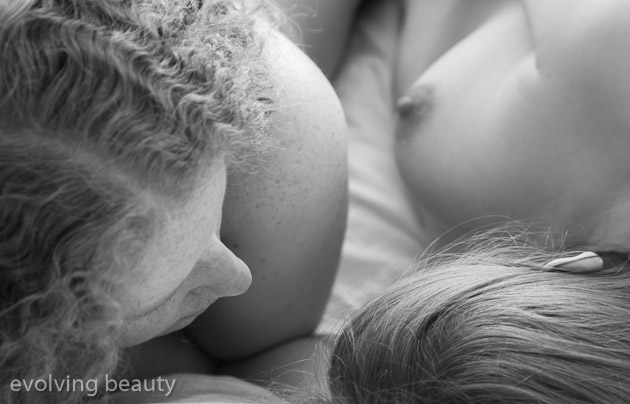
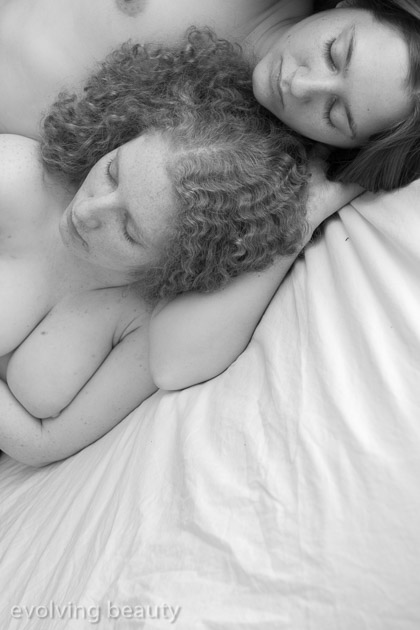
Often, when working with multiple models who are not intimately involved (i.e. who are friends, not lovers), there is a little hesitance on my part to suggest poses that might be construed as too personal, but with Miranda and Monique there was already such a comfort level between the models that this wasn't an issue (this was not at all surprising, given Miranda's previous comfort with working with other models, most recently Kylie). It is not that the images are particularly intimate or erotic, more that the kind of closeness that is required of models to create the images we made during this session is not something that is reasonable to ask of models that are not comfortable with each other.

March 27, 2004

Miranda and Monique in Moncton

It seemed oddly appropriate to spend the evening after a full day in Halifax spent teaching a Studio Lighting Workshop in a studio working working with models. The previous week, Miranda told me of a friend of hers, Monique, who was interested in working with me; I had met up with the two of them the night before to talk about working them and the only time both Miranda and Monique had available before I left to return to Moncton was on Saturday night, so after dinner, we met up, and by 9:30 pm, the session was under way.
8"x10" film
One interesting side effect of teaching is that it makes me far more conscious of my own working practice than I normally would be. After spending the day talking about a variety of lighting set ups for different situations, I was painfully away of how simple my own approach to lighting is - over the two hours of the session, I only worked with two lighting set-ups - one with two lights, and the second with one.

I think the simplicity of my approach to studio work is rooted in my innate frustration with the process - I'd rather work with the nuances of pose and camera position then obsess over lighting each and every image to the max. This works well for me, and certainly makes a studio session move along swiftly. Without an assistant, readjusting the lighting more then a couple of times a session would really slow down the process.
Digital original
For a model posing nude for the first time, the studio is a double edged sword - it is a small, secure space with no chance of interruption, a warm, draft-free environment to pose in. By the same token though, the entire focus of the studio is on the model - they stand in the light, and everything is centered upon them. For Monique, a first time model, this was tempered somewhat by the fact that she was working with Miranda, who is more then comfortable with the whole process. If there was any hesitation or nervousness on Monique's part, it was gone by the time we actually started working, with standing portraits of Miranda and Monique.
Digital original
The session went much as I had expected; Miranda and Monique working comfortably in both aesthetic and more personal images, though as the session evolved, I quickly let go of focusing on the abstract, and concentrated on the chemistry between the models. From previous sessions with Miranda and other models, I had guessed the session would focus on the interplay between the two models; Miranda has a knack for putting other people at ease, and this shows through in the images, even with a first-time model.

March 22, 2004

An Indoor Session with L_

The last session of the Halifax trip was at L_'s apartment and was as good a proof for my approach of never planning ahead as I have ever had. Often when presenting on my work, I'm asked how I come up with ideas, or bring a concept; my answer is always the same, I don't. About as far as I come to planning a session's images is deciding (with the model) where and when we'll work - if it's outdoors, I usually defer to the model's preference for setting, and indoors, we just work with what presents itself, in the way of lighting and settings.
Digital original
The first time I'd worked in L_'s apartment was shortly after she moved in, and there was little in the way of furniture or clutter. This time, however, I'd expected to need the white sheets to simplify the setting, and create the kind of space I enjoy working with. All that changed when I walked into her place; as part of an art college project, L_ had been working with self-portraits in mirrors, and had a number of full-length wall mirrors in one of her rooms. We actually spent the first fifteen minutes or so just looking at her project, and discussing what she was doing with her images, before even considering what we'd spend our time together doing.

In the end, the lure of the mirrors was too much to resist exploring (I had produced an entire body of work with the Nude on mirrors between 1999 and 2001). Initially I was worried that L_ would see my asking to photograph her with the mirrors as in imposition on her already-in-progress project, but she said it would be interesting to see how I worked with the same foil she had been using for so long.
Digital original
I had an odd sense of deja-vu for the entire session, as over and over, I would catch glimpses of what initially had drawn me to working with the Nude on mirrors - the magical ability to see what was hidden from the main view, the incredible repetitions that could occur quite suddenly because of the twist of a hip or the movement of an arm. All this was layers over the very different setting of working in a room lit by daylight, and with multiple mirrors, as opposed to just one. In some ways, I think the addition of the mirror is as dynamic as the addition of a second model - all of a sudden, there is not just one pose to be considered, but two (or in this case, three). The richness of the visual plane increases with the reflections, and everything immediately becomes more complex.
Digital original
As enjoyable as the mirrors were to work with, I didn't want the session to be a totally experimental one, so after spending most of our time (and the afternoon's light) working with them, I shifted to a portrait approach, and moved with L_ into her bedroom, to make a series of images on her bed. The light had dropped quite a bit by this point, and while I did make some images with the 8"x10" camera, there just wasn't enough light to work effectively, so I very quickly just settled to working with the digital camera. Again, the loose, open composition approach that I have been experimenting with since January came into play, resulting in images about a body in a space, as opposed to my more traditional tightly-framed portraits.

Photographing Natasha in Natural Light

The second (and final) day of my short Halifax trip started with me working indoors at Natasha's apartment; I hadn't seen the space before, but given the small and dim rooms I'd worked in to date, I assured her that as long as there was a decent amount of space and some light, it would work out fine. As it turned out, the room she made available to work in had a large window facing a white sun-lit building, perfect for providing a soft directional light.
8"x10" film
On the surface, the session was quite similar to the previous day's session, with soft window light and a white couch but really situation was quite different. Where the exposures from the previous day was quite long, the bright light in Natasha's apartment made it quite easy to work with the 8"x10" camera, and the white futon turned out to be a wonderful setting for the images, with quite a different quality from the sheet covered couch from the previous afternoon.

We began with Natasha lying on the couch - the obvious thing to do I guess, but with the bare wall above the couch, I immediately wanted to work with a vertical image, with a Nude curled at the bottom of the frame (again, an image strongly influenced by a nude of Kylie against the wall made in January). The balance between such a simple wall, place din two third of the image, and the futon and Nude placed at the bottom seemed to call out to me directly. I had thought that the room size might be a problem, but as soon as I put the 150mm wide angle lens on the camera (equal to a 24mm lens on a 35mm camera) I actually had to move the camera closer to the futon to frame the image as tight as I wanted to be.
Digital original
 Because of the higher light levels, this session was a more natural mix of digital and film than many of the sessions to date have been. From the beginning of the year, most of the sessions have focused on digital images, with the view camera brought in when appropriate images presented themselves, but with Natasha, a number of images started at 8"x10" compositions, and the digital camera was only introduced after the main image was recorded.
Digital original
From the opening images to the end of the session, the good light persisted, and the minimalist setting helped keep the compositions and poses simple and classical. Natasha worked lying on the couch for about half the session, until we shifted to making some portraits, first sitting up, and then (as for the portrait to the left) standing on the couch (I had her stand on the couch so she could lean against the wall - that gave enough stability to the poses to permit working with the view camera). All in all, the images from the session have a quiet strength to them that I find quite appealing - as much a testimony to Natasha's poise and presence as to my ability to record what is present to work with.

March 21, 2004

Kylie & Miranda Model Together

Shortly after my last session with Kylie, I was thinking of asking her if she had any interest in working with another models (male or female) when she asked me if Miranda might be interested in modeling with her. I've always been surprised by the comfort of some models in working with others (it is never a surprise when models work with their partners, but it is different when they work with a model they are not intimately involved with); there is an obvious connection when the models are already acquainted (like the New Year's day session with L_, Elisabeth and Krista), but in a number of cases, models have asked about working with other models without having met them first. I think the main motivation for this is appreciating my work with multiple models, and being curious about what they could contribute to that collection of images; with Kylie, it was as simple as wishing to vary the breadth of the work we've produced to date.
Digital original
As I suspected, Miranda was more then comfortable with the proposal of working with Kylie, and during a short weekend visit to Halifax, we were able to work out a time that suited all three people involved. The space we had to work in was both small and a little dim, so even before we started the session, a lot of work was put into moving the furniture around to maximize the working space. Nothing much could be done to increase the light - in warmer weather I would have opened the deck door to let in more light, but there was freezing rain outside (part of the reason the light levels were so low), I thought it better to keep the door shut!
Digital original, 3 frame stitch
The session actually started out with some standing images, silhouetted against the central window of the door, but these didn't work as well as I have hoped, so we quickly shifted to working on the couch, making a series of images of the models intertwined and relaxing. It is this point that I am always the most anxious about; if the chemistry of the models doesn't mix, there is an obvious tension to the images that can be hard to work around. With Kylie and Miranda, however, there wasn't any problem with comfort, and the first image saw Kylie leaning back into the couch, and Miranda collapsing across her legs. Because of the small room size, I had to fight to keep the composition within the frame with the 8"x10" camera, but the composition was just possible, and very striking.
Digital original, 3 frame stitch
The rest of the session was spent working on variations of the same, either Miranda reclining and Kylie fitting into the pose, or the other way around. Because of the low light levels, I concentrated on working with the digital camera, but whenever an image look particularly strong, I would take the time to record it on the view camera. The only real exception was the final image of the session, with Miranda sitting up, and Kylie lying on her front, looking at the camera. As soon as I saw it (a non-pose of the models simply waiting for a decision to continue working or end the session), I knew it would make a great portrait image. To get the right perspective, I had to be right against the far wall - a position that was impossible with the larger camera. I made the image with the digital, breaking it into two stitched vertical frames to keep the image as high quality as possible.

March 12, 2004

A Couple in Montreal

The last figure session of the Montreal visit was also the one most short-changed by the hectic schedule. I had intended the session to run from 1pm until the light left (around 4:30), but due to a change of plan with the gallery I was presenting work to, I had to wrap the session up by 3pm. This gave only two hours for the session, and while this might have been more than enough for a short session with experienced models, this was my first session with Mary-Jane and Mattaeo, which by necessity meant much of the session was spent just getting the models comfortable with the process.
Digital original
For this session, the issue was even more emphasized by the fact that I hadn't had a chance to sit down with with the models before the session to discuss my work and their expectations. While this was a less than perfect situation, Mary Jane assured me that it wasn't an issue, as she'd been through my site, and was quite familiar with my work as a whole (though in hindsight, she did mention she likely would have responded much differently to the process if she'd had had the meeting with me before the session).

While the intent of the session was to work with Mary Jane, her partner Matteo accompanied her and, as we were setting up for the session, Joy asked if he was planning to model as well. After a short and somewhat scattered conversation/debate, he indicated he wasn't opposed to the possibility, if an image presented itself. I told Matteo that one of my favorite subjects to work with was couples and that if he was comfortable, I'd be sure to take advantage of his presence.
Digital original
I began the session with a series of portraits of Mary Jane, both to get a feel for how she responded to the camera and how she photographed. Once those were finished, I shifted to working with her sitting in front of a suspended white sheet - this space had been set up for Marie-Eve but to work with Mary-Jane, I shifted it to be perpendicular to the windows, creating a space that was side-lit, as opposed to front-lit.

After a couple of compositions on her own, I asked Matteo if he'd like to contribute his arms to the image (this both completed what I saw as a potential image through the viewfinder, and gave him a first step to working fully nude). After a whole series of images revolving around Matteo embracing Mary Jane from behind, I change the setting again to working standing by the windows, and asked if Matteo was ready to do some fullbody poses. He jumped right in, and for the remainder of the frustratingly brief session, I worked with the two models.
Digital original, 7 frame stitch
It is a wonderful gift, being permitted to photograph a couple together - there is a natural energy generated by two people so comfortable with each other and this, combined with the intimate quality generated by the nudity, leads to undeniably personal photos. Many of the couple I've worked with have been good friends, but even in a situation like this sesion, where the models have never met me before, because the session focuses on the chemistry between the models, the images are just as striking, giving voice to the tenderness and affection between the models. The only thing lacking from the session was the time to take full advantage of the potential unfolding before me, in the embrace of the two models.