July 17, 2005

Miranda and I do a Demo for a Workshop

The last half of my final day of photographing for the New Brunswick Portfolio was actually split between a short indoor available light session demonstrating working with view cameras, and a last series of images working in the trees and ferns of southern New Brunswick.
Digital infrared original
Well before the time-table for the New Brunswick portfolio was set, I had committed to presenting on my work at a Large Format Photography Workshop being held in Hampton. The initial plan had been to not only show my images, and talk about my technique, but also to provide a short demonstration of the working process with a model present. As it turned out, with the workshop coinciding with the final weekend of the Miranda portfolio, I was lucky enough to segue the portfolio photography with the workshop, and no only present my work to the group, but make a couple of image of Miranda with the 8”x10” view camera, lying on a couch (a nice change for her from the rocks, trees and earth of the previous six days)
Digital infrared original
After finishing up with the formal demonstration for the workshop, Miranda and I headed out into the woods that surround much of Hampton , and made our final images of the portfolio. For a variety of reasons, woodland images have been under-represented in the work Miranda and I did over this week. Primarily, it was concerns over bugs and pests (with both Lyme and West-Nile disease present in New Brunswick, what used to be just fear of bug-bites and itching has now turned quite distinctly, into a valid concern over long term health). Also, there is my constant frustration with the sameness of woodland – for the most part the forests of New Brunswick would be interchangeable with those of Prince Edward Island , Nova Scotia , Maine or even Quebec, with little to distinguish one space from another.
4"x10" film
All this said, I still felt, on the last day of the portfolio, that it was imperative to make at least an attempt at creating a set of images focusing on the woods. The light was harsh when me moved into the woods, but simply by placing it behind Miranda, and using it to provide rim lighting to her, and back lighting to the trees and ferns around her, I controlled the contrast well enough to make a number of very pleasing images. The final photograph of the portfolio however, was not quite fully Nude. It was a standing portrait of Miranda, bedecked with her bright orange hat, smiling quietly into the camera just after I'd informed her that we were done – that the last photograph of the Miranda portfolio was about to be made. A fitting end to a busy, at sometimes hectic, but definitely rewarding week of work.

July 16, 2005

Miranda XVI

The final day of the New Brunswick Portfolio was in many ways the least planned of the entire project - Miranda and I knew where we'd be, near Hampton (see below), but as it is an area of the province I have only been once before, I didn't really have an idea as to what we would do when we arrived in the area to work.
8"x10" film
The one thing I did know is that I wanted to focus on working with the view camera - because of the poor weather over the entire week, I'd had almost no opportunities to work with the 8"x10" camera, and with the last day of the project upon us, I felt almost compelled to focus on that tool to the exception of the digital cameras. This is not necessarily the best reason to chose one particular camera format over another, but given how much work I have done in the past with view cameras, I feel somewhat obligated to have at least some of the portfolio produced with one.

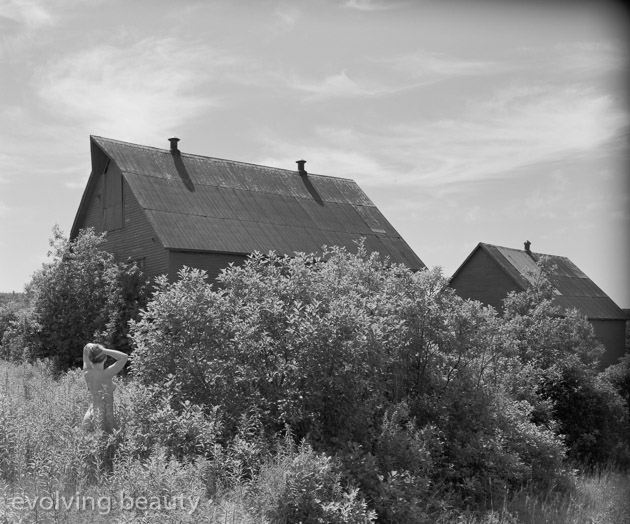
After investigating several different location on our drive towards Hampton, Miranda and I finally settled on working together at an abandoned farm - it was right beside the road, but with the large buildings and high brush shielding most of it from view, we felt confidant that it would be more than shelterd enough to work at.
8"x10" film
With a location selected, the next problem to solve was the lighting - though the morning had started out lightly overcast, as we'd driven south, it had become pregressively more and more sunny. The first set of images we made were produced int he only shade we could find - along side the barn, in a patch of share only about six feet wide. This worked out well for the image though, with the light upon Miranda coming from both the sky above, and the sun-lit grass to her back.

The rest of the images at the farm were made in the sunlight, using contraction development to control the contrast (this basically means that more light is captured on the film by exposing it at a lower ISO (in this case, 100), and in the darkroom with over-exposure is compensated for in the development, which ends up giving the image more shadow detail than would normally have been present). In the end, after working together for close to an hour, I was satisfied that we'd made what images could be produced given the direct light, and the space, so we packed up, and headed off to Hampton, lunch, and our final afternoon of photography.

July 15, 2005

Miranda XV

The primary reason for Miranda and I to journey so far north of Moncton for the second-last day of the New Brunswick Portfolio was that we were hoping to work alongside the Miramirchi river, one of the largest in the province.

The only real barrier to our plan was the fact that neither Miranda nor I had actually been to the Miramichi before, so were were to a degree, wandering in the dark. As we began driving down the river (the highway follows the river) both Miranda and I kept our eyes open for possible spaces to work. Several times we stopped to investigate a location, only to find it was appropriate for a variety of reasons.
Digital original, 3 frame stitch
Going over a highway bridge however, I caught a glimpse of old bridge supports, and asked Miranda if she'd be up for checking out another space. A quick look confirmed the place had good potential, so after parking the car and getting the cameras, we scrambled down the embankment to the river, to see exactly what could be created.

Because we had walked down right besides the bridge, it was quite easy to work without being seen, even thought there was a fair amount of traffic passing on the highway overhead (the bridge was perhaps fifteen metres above). The session started with Miranda posing on the narrow verge between the forested river bank and the Miramirchi, but very quickly, we shifted to working with the old concrete bridge piers.
Digital original
I do find it ironic that I headed up to the Miramichi in hopes of making water nudes, and ended up being most engaged by an architectural element, but regardless, as soon as we started working with the piers, the images started coming fast and furious. Initially I had been concerned about how I'd work with such a massive structure when Miranda couldn't approach it (it was out in the river channel) but through using a wide angle lens, and careful composition, I made a good number of successful compositions, one of which ended up being included in the portfolio.
Digital infrared original
After finishing working with the bridge pier, Miranda and I walked along the riverbank to where a broad stretch of watergrass grew on a small sandbar. I'd hoped to make some full-immersiuon water Nudes with Miranda in the river, but the bottom was just too suspect for Miranda to lie upon, so instead, she walked out into the water, near the sandbar, so I could make a series of panaramics. WIth this done, and the sun moving down further in the sky, we began our three hour drive back to Moncton for the night.

Abandoned Buildings


Digital infrared original

After leaving the beach, and spending some time recovering from all the sun and wind, Miranda and I proceeded to drive slowly down the Miramichi, looking for more spaces to work in (we'd gone so far north with the intention of working along the Miramichi River, which is one of the largest in New Brunswick). Just east of Miramichi City proper, through the screen of trees along side the highway, I caught a glimpse of something distinctly industrial looking, so we pulled off the road, and set out to investigate.
Digital infrared original
In a large and empty landscape strangely reminiscent of that which surrounded the Sydney Steel Coke Ovens, we came across two large abandoned structures (I hesitate to call them buildings, and I don't think they fit that description, lacking both doors or windows). There was no real indication of the purpose of the four-legged behemoths, though they were certainly designed to load something onto trains (logs? wood pulp?). In the middle of the thick woods of New Brunswick, such a large and empty space, dominated by such out of place objects made them seem very lonely and abandoned.
Digital infrared original
Initially I considered spending some time working with Miranda among the buildings, but because the space was so open and exposed (there really was no concealment from view for hundres of metres in some directions) I felt it was better to just focus on the structures, and the landscape itself. Had I not been in the middle of producing the New Brunswick Portfolio, I might have spent longer in this location, but after fifteen minutes of exploration, and making perhaps three dozen images, Miranda and I headed back to the car, back on the highway, and back to work.

Miranda XIV

In contrast to the previous day (where the rain and drizzle never stopped), this day dawned with a clearing sky, and promised to get even better. Miranda and I had already planned to drive north, to avoid any lingering weather from the previous day, so by mid morning, we were several hours north of Moncton, looking for a place to photograph.
Digital infrared original, 2 frame exposure blend
Without any local knowledge I had to go intuition, and aided by a good map, Miranda and I found our way to a long, nearly deserted beach. By this time the sun was rising in a clear, blue sky, so we decided that spending a couple of hours working on a beach, with a cool breeze off the ocean wouldn't be a bad plan.

Though the beach was deserted when we arrived, given how lovely the day was looking (in the eyes of a sun-worshiper), Miranda and I decided to walk a ways down the beach before starting to work. This not only put us far enough away from the parking area and any interlopers, but it gave us both a time to become accustomed to the space, and develop some idea for images.
Digital infrared original
On the whole, flat level beaches are difficult to photograph on - there is little in the way of landscape to take inspiration from, so instead of focusing on the beach itself, most of the images from this session focus on the anomalies - driftwood, old dead trees, and other debris lying upon the sand. Beacuse the light was so harsh, it was difficult to compose many of the images I tried to make - often the best angle photographically had the wrong lighting, so many of the images were compromises between the best angle, and the best light. Working with the infrared DSLR helped somewhat, as the camera lends itself to contrast situations, but still, much of the session was spent fighting to balance the pose with the light.
Digital infrared original
Miranda and I actually spent much longer on the beach than I had anticipated - more than hald of the four hours was spent walking, simply getting to the spaces in which we ended up working. And as frustrating as the bright sunlight was to work with, but Miranda and I quite enjoyed the weather, between the warm enveloping sun, and the cool wind off the ocean.

July 14, 2005

Miranda XIII

This was the most frustrating day of the New Brunswick portfolio – it dawned with the tail end of a tropical storm washing over New Brunswick , and rain and wind forecast for the entire province. Still, Miranda and I set out in the morning with the optimistic goal of driving until we found somewhere where it wasn't raining. This turned out to be more futile than I'd imagined, and by the end of the day, we returned to Moncton, a little disheartened, and 650km further along on the car's mileage.
Digital original, 26 frame stitch
All that being said, we did manage to work in one location - a tree-filled vallery between two low rolling hills. The rain never really stopped at any time during the day, but for this breif period, it was light enough that Miranda said she didn't mind working on a single pose, just so we could say we did one image over the day.
Digital infrared original, 25 frame stitch
In part because of the rain, the light was unusually soft in the river-valley, and this particular space, right by the dirt road we'd driven up on, was somewhat sheltered from the rain by the overhanging trees. I pre-stitched the entire composition (4 rows of 6 frames each row) with both cameras before asking Miranda to take the pose (she was hiding from the drizzle in the car), ensuring that she'd be exposed to the elements for the minimum of time. Once I was ready, Miranda dashed from the car to under the trees, and worked through a variety of poses, and then repeated the process for the second digital camera. In less than a handful of minutes, the images were made, and Miranda was back into the car, boosting the head and getting her clothes back ok.

And the best news of the day was that the images all worked - especially in the infrared, the magical quality of the rainy day translated beautifully into the final image.

July 13, 2005

Miranda XII

After a well-earned and restful dinner, Miranda and I set out again for Bellville, to work with the trees and fields with the lowering sun (I would have loved to stay right to sunset, but with two hours to drive back to Moncton, I had to balance the beauty of the light with the practicality of getting home at a reasonable hour).
Digital original
The fields and trees we worked with were directly behind the abandoned house we'd worked with several hours before, but provided a vastly different setting to work in. Over dinner, the sun had finally come out from the clouds, through over the entire session it alternated between sunny and clouds so swiftly that if the light was wrong for a particular image, all we had to do was wait a couple minutes, and it would change.

Normally I prefer to work with diffused light, with with the setting sun, but the angular light was perfect, flooding across the fields, and providing wonderful modeling to Miranda's figure.When we were working with the line of trees dividing two of the fields, the side lighting also picked up Miranda's hair colour, making the images particularly successful in colour (the warmth of her golden-brown hair provided a beautiful contrast to the cool greens of the grass and trees).
Digital infrared original, 8 frame stitch
When we moved out to work in the field itself, I changed my approach for the first set of images, asking Miranda to work with a single fence-post, and waiting until the sun was behind clouds before making an image. I took inspiration from a photo I'd made of Victoria in Alberta, when working on my first portfolio in 1999. Waiting for the light to be even helped set the delicate tonality of Miranda's evenly lit figure in the field off against the stark contrast of the sky, with the white clouds set against a dark gray.

The final images of the day were made of Miranda sitting among the Timothy grass in the field, with the low sun back lighting her figure, and setting it off against the surrounding grass, which became a sea of light gray on the infrared camera. After ten minutes of exploring with working in the field, Miranda and I called it a session, and headed for Moncton.
Digital infrared original, 3 frame stitch
Hindsight being perfect, this day proved the most productive of the portfolio - the weather was ideal, starting with high overcast, and ending with intermittent sun, and with a guide, we had the opportunity to work with a number of spaces we couldn't have found on our own. It was also one of the few days that permitted the use of my 8"x10" view camera (most of the other days were just too damp to bring it out on) .

Miranda XI

Abandoned houses are some of the richest spaces to work in with figure models, being both haunting visually, and generally quite private. Miranda and I have only once worked together in an old house, but the images from that session were so successful, I was quite hoping to have the opportunity to do so again, during the creation of the New Brunswick Portfolio.
8"x10" film
Fortunately, our guide to the area around Woodstock had already scouted out several locations, including one beautifully weathered house alongside the road in Bellville. A quick exploration revealed numerous spaces to work in (sadly, the stairs to the second floor were removed, so we were limited to working on the main floor only), and in relatively short order, we'd set up and started making images.

The majority of the photographs Miranda and I made in the old house revolved around window light, both because this was where the brightest light was, and where the most beautiful light could be found. One interesting element to working in a man-made structure like a house is that it lends itself to upright poses, where many natural settings tend to work better with extended prone position (stretching out on rocks, or curling up in a pool of water). This helps inject some variety into the resulting images (sometimes my work is criticized for containing too many elongated, prone poses).
Digital infrared original, 3 frame stitch
As we worked within the house, I was somewhat oblivious to the weather outside, but as I changed my approach to using the outside of the house I started to have to consider the light - by this time, the sky had cleared enough to permit the occasional patch of sunlight to come through, and as welcome as these were as a sign of the end of two days of rain and drizzle, the harsh sunlight on the weather-worn white building was hard to work with. For the first image, looking into the building to see Miranda looking through another window, it was crucial to have the light on the building as soft as possible, so we had to wait until the sun was behind clouds before making the image.

The final series of images Miranda and I made with the abandoned house focused on working with the doorway on the side of the building. I chose the space both because of the wonderful skew to the door, from the slow decline of the house, and because it was sheltered from the direct sunlight.
Digital infrared original
The session in the house was perfectly spaced within our day - with the arrival of the intermittent sun, the afternoon had warmed up considerably, with some of the most difficult light to photograph in, so the chance to work with window light and doorways was most welcome, and while the house was definately in decline, it was more than safe enough structually to accomidate out attentioned for the afternoon.

Miranda X

The primary reason to travel up to Woodstock was to take advantage of the local knowledge, and the third location proved that point ten-fold.
Digital infrared original
Accessible only via a fifteen-minute drive down an abandoned rail-bed, the marshland at Linsday initially seemed somewhat of a let-down - the real space we'd been intending to work at was another couple of kilometers down the rail-line, but a deep trench across the railbed (to discourage cars driving along the line) put an end to out plans. Not wanting to just admit defeat however, before backing the car out along the narrow track, Miranda and I got out of the car and took a look at the possibilities the space offered (which, to be honest, wasn't much, given that between the water on one side, and thick scrubby woods on the other was a 3-metre wide rail-bed).
Digital infrared original
Initially, I wasn't sure that there was anything to work with, until just by chance our guide walked into the high grass that grew between the marsh and the railway - while the overall surroundings were none-too inspiring, the glimpse of her against the wall of grass was enough to bring everything to a stop, and provoke me to ask her and Miranda to change places. A couple of minutes later, we'd started working, first with Miranda in among the grass, and then, standing in font of it. Using a portrait lens (a 50mm on the DSLR) on the infrared camera have me exactly what I was looking for, with the unexpected side effect of having the tipos of the grass go dark, an almost magical look for such a mundane space.
Digital infrared original, 2 frame stitch
The final set of images in the space were also the most inspiration, leading to the first image I knew would be in theNew Brunswick Portfolio. Just beside where the car was parked lay a small bed off grass, splaying out in a radial pattern - I asked Miranda if she could pose in the centre of this, and within five minutes one of the most beautiful images of the entire week had been created, in the middle of a space that was simply "on the way" to somewhere else.

Miranda IX

Our second location near Woodstock was an abandoned farm, a mirror of my experience with Victoria in Alberta, although unlike that session, almost all our images at this farm were made within the buildings. Though the clouds were still dominating the sky, the weather was well on its way to clearing by the time we started working, but given the poor weather of the previous two days, all the images I'd pre-envisioned were under shelter, more out of caution than any real risk of rain.
8"x10" film
The first set of images were made in a open-sided barn, where a number of older hay bales were still stacked. An abandoned truck bed gave me a solid platform to work from, and interesting elements (the fold-down ramps) for Miranda to interact with. The first images we made were a series of pose explorations made with the DSLR, alternating between standing and crouching, and facing towards and away from the camera. Out of these experiments came my final pose decision - Miranda positioned low with the two bales swirling out over her outstretched arms. Once I was certain I'd made this image successfully with the infrared camera, I switched to the 8"x10" camera, and recomposed the image. Miranda found the pose again with relative ease, and within a couple of seconds, the film version of the image was made. Ironically, though the film image was made with the larger, slower-to-use view camera, it was the digital images that took a long time to make, as I created the final image out of an eighteen-frame multi-row stitch).
Digital original, 8 frame stitch
The other compositions from this location both focused on the same window - the first from outside, the second, from within. With so little of the New Brunswick portfolio to date involving architectural Nudes, I deliberately made the most of the first buildings we had to work with. Without a doubt, my favorite light to work with is window light, so to begin, I went against my instincts, and experimented with the view from the outside in, working from beside the building and looking through the window at Miranda. I debated over using a polarizer (literally, for the first time in a non-teaching image) to remove the reflection, but ended up feeling I liked the third layer to the image's depth (the window, the window behind it, and the reflection upon it). As we'd done in the open barm, once I'd set up the camera and made the base image (a large stitch of the window and building side), Miranda simply experimented with pose and position, each of which was dropped into the final images later in the computer.
Digital infrared original
The final images of the session were made with the window-light I love so much, augmented by the light coming through the doorway behind me (which is why the final portrait has less direction to the light than would usually exist with a window-light portrait). Before we packed up and departed, there was a short debate about working with the fields and trees around the farm, but given its proximity to the road, and the fact we had the whole rest of the day to work with landscape, it was mutually decided that the architectural images had made the most of the space.