June 26, 2005

A Second Session in South-West Pubnico

After a couple of hours of working on the islands, Jane and I returned to the mainland, only to discover we still had another hour or more of good light available to us. Jane suggested a quick drive to the other side of the bay; less than fifteen minutes later, we were walking through a very different afternoon: here the sky was shrouded in fog and what had been harsh, direct light on the islands had metatmorphed into soft, diffused light. With considerable enthusiasm because of this improvement, we walked down the beach until we found a good place to start photographing.
Digital infrared original, 18 frame stitch
We were fortunate to arrive at low tide, when the water-worn rocks were fully exposed, permitting Jane to work her way into the curves and flow of the stone. In stark contrast to the rocks in east Pubnico, which were granite, the stone here was smoother and darker, giving Jane a more comfortable setting in which to work, and setting off her pale skin.

As the light was so consistent, and the setting so striking, I made almost all the images here as multi-image stitches - this both increased the resolution of the final images, as well as permitting me to choose my perspective and composition independent of the lenses I had with me and the shape of the DLSR image (2:3 proportion, like conventional 35mm cameras). This does slow the photographic process down quite a bit but I've found models are more than willing to accommodate the slower workflow in exchange for the results, which can be quite stunning, both in terms of the image quality and the occasionally exaggerated angle of view.
Digital infrared original, 5 frame stitch
Beside the dark smooth rocks, the second visual element which worked well in Southwest Pubnico was the rockweed. Normally dark brown, on the infrared digital camera the seaweed turned luminous white, providing welcome tonal contrasts in the images of Jane in the rocks. In conventional black and white, the rockweed would have simply faded into the tones of the rocks, but in infrared, its pale textured highlight provided some contrast to the smooth, pale tones of Jane's body.
Digital infrared original, 4 frame stitch
Sadly, due to time restrictions, we had to call the work in the fog to a close well before I had exhausted all the possibilities. If it hadn't been such a long drive from Halifax to Pubnico, I could have spent all day in either the island or shoreline locations in which we worked in a single afternoon. All I can do is hope for another chance to work with this varied and wonder fill landscape in the future, perhaps during a longer visit.

June 25, 2005

Infrared Skies

Digital infrared original

Usually my drives from Moncton to Halifax are functional - with fairly rigid time tables due to teaching or photographing upon my arrival. This visit, however, involved a drive at the end of the day, and meeting up with friend, so there was less pressure for a swift trip. What this really provided for was the opportunity to drive with an eye open for photographs, and to stop if necessary.
Digital infrared original
One of the greatest differences between Halifax, where I lived for more than thirty years, and Moncton, where I moved two years ago, is the skies - in Moncton, because of the flat surrounding landscape, they tend to vast and broad with layers of clouds. On this particular evening, the sky was
full of dramatic clouds, towering over head and letting the sun burst through in regular intervals as it moved towards the horizon. As I was driving east, this spectacle was ever in my rear-view mirror,
and four times over the drive to Halifax, I pulled the care off the highway and made images of the magnificent sky behind me.
Digital infrared original
Even though I only worked with the infrared converted Nikon D70, the results conveyed the full impact of the clouds and setting sun. "Godsky" is how I have come to think of the rays of light bursting through cloud cover, and Godsky it was, almost continually until the sun moved below the horizon.

June 19, 2005

The Year's First Session with Miranda

Miranda and I have not managed to work as much this year, partially due to the fact that she now has a full-time job, and partially due to the plans we have made for a New Brunswick Portfolio, to be produced in July. Fortunately, on this particular afternoon, Miranda was available, so we headed out to a new location, a river near Pennant Point.
Digital infrared original, 2 frame stitch
I had seen photos of the river before, but wasn't prepared for how wonderful it would be to work on with a model - there were plenty of conveniently placed rocks in the river, and while the water flow was significant, it was nothing dangerous to walk through. All this, sadly, was offset by how bright and sunny the day was - using neutral density filters I was able to get exposures down to 1/4 of a second, which isn't nearly long enough to get the fluid water blur I am so attracted to in water Nudes.
Digital infrared original
Working from the rocks around where I'd posed Miranda, I made a number of different compositions and attempted a number of multi-frame stitches, to increase the final image resolution. I say attempted, because while the day was generally bright and sunny, there was low, fast moving clouds that occasionally offered tantalizingly beautiful light for fleeting instants. Numerous times, I started a stitch, only to have the light shift half-way through, effectively disrupting the process. About the only positive outcome of this is that it led to the creation of a number of interesting incidental compositions, originally intended to be part of the stitch, but viable images all on their own merit.

The end of the session saw Miranda and I moving to the edge of the river and working with the trees that bordered it. Several had grown at very strange angles, flowing out and over the rocks and providing a perfect space for a model to perch.
Digital infrared original
While I did make some 8"x10" negatives during the session, all the water-orientated images were made with the infrared Nikon D70, taking advantage of the smaller camera's inherent speed and ease of handling. Even in the harsh sunlight, the infrared camera did a wonderful job rendering what caught my eye and converting it into a striking photograph.

June 18, 2005

Miles & Natasha at Lawrencetown

After a foggy and gray morning, the sun made an appearance in the midafternoon, warming the day up and giving some hope to the idea of an evening session; Miles and Natasha had met up with me for a brief dinner, and after some debate over plans, we decided to drive down to Martinique Beach to work with the sunset light. As we left Halifax, we drove into a solid wall of fog and very quickly revamped out plans; as opposed to driving forty minutes to a fog-shrouded beach, we decided to take a shorter twenty minute trip to a closer beach at Lawrencetown – different beach, same fog bank.
Digital infrared original
I spent the first half-hour or so simply walking along the beach and working with the infrared converted Nikon. There is a child-like wonder to making images and not quite knowing what to expect on the viewing screen; kelp especially fascinates me, as it is so dark and rich in tone to the eye, and in infrared, it is luminous and pale – it has the same surface sheen, but instead of a dark and brooding tone speaking of the depths of the sea, it is pale and delicate in tone, as if looking for a mermaid to adore.
Digital infrared original, 12 frame stitch
Though the light levels were dropping, and the exposures were getting longer (infrared light seems to be strongly reduced in fog), when I finally made it down to where Miles and Natasha had walked to, I was still eager to work with them, though it would by necessity be a short session. I selected a patch of sand surrounded by beach grass, and directed the two models to start working there.
Digital infrared original
The first poses were simple, working with two models entwined upon the beach (I couldn't help but think of it as a mermaid embracing her mortal lover), but with the light dropping as fast as it was (for the infrared camera at least) I thought it would be best to try a different approach for the last light of the evening. I asked the models to get up and work with simple embraces, first with both standing and then with Miles kneeling before Natasha. I have long determined that I have a strong preference for images of women being worshiped by their lovers, so the final pose of the day seemed totally appropriate.

June 17, 2005

A first Session with Jane

Jane and I had laid the plans for working together more than two weeks earlier; we both live equidistant from Halifax, but in opposite directions, so the easiest place for us to meet up was Halifax. As I was teaching a workshop this weekend, it was the ideal time for me (I try hard to make the most of the infrequent visits to Halifax). As the day drew closer, however, the weather forecast started to look more and more doubtful, with rainy day after rainy day presenting themselves and threatening to cancel our plans before they could even begin.
Digital infrared original, 2 frame resolution blend
As it happened, though the day was gray and overcast, the rain that was forecast never arrived. Jane and I discussed the options and, though the day was a little cool, she declared that it would be worth a try, so we set off for York Redoubt, to work in the shoreline battery and rocks along the harbour.

As is my preference, I began the session simply, making a series of standing portraits in one of the small rooms within the shore battery. The light was low but delicate, and it gave Jane a chance to be introduced to the process without too much expectation in the way of pose or position.
Digital infrared original, 16 frame stitch
While I did use the 8”x10” camera during the session, the vast majority of the focus was working with the infrared converted D70. It was so refreshing to be able to work with particular palette that infrared light brings to an image, and for a first session with a new model (on a cool day), the faster workflow and more immediate feedback the digital SLR brought to the process was quite welcome.
Digital infrared original

Throughout the session, I kept a weather eye to the sky, constantly worried that the heavens would open, and the rain would come. In the end, however, we worked for more than three hours, finally calling a close to the session on account of the low air temperature, as opposed to rain (by this point, I had been soaked up to my knees by rogue waves and Jane had been splattered by more than her fair share of ocean spray). The day's images ranges from architectural nudes to Jane posing by the ocean, and experiments with long exposures. Without a doubt, a very successful first session with a very indulgent and enthusiastic new model.

June 13, 2005

An Indoor Couple

Kayla and Tom both enjoyed their first experience modeling and were both keen to model again.
Unfortunately, the afternoon on which we'd planned to work was rainy so we had to cancel the outdoor session. Both models were still enthusiastic to work, however, so we decided to change the approach and do a natural light indoor session. Though they weren't an actual couple, Kayla and Tom were more than comfortable posing together.
Digital infrared image
Even though the day was wet and dreary, there was plenty of light to work with, even with the infrared camera (this came as something of a surprise, as I had expected a rainy-day indoor session to be impractical). I set the two models up on the futon below the window at the end of the living room and began to work, focusing on the flow of the light over their bodies and the casual touch and intimacies that developed between them.
Digital infrared image, 2 frame stitch
Unlike the three-model session two days earlier, there was little difficulty with the presence of the second model - the interplay between the two propelled the images forward, and helped create images that wouldn't have occurred with a single model. As much as I can do to help a model find a pose or create an image, having two models working together makes the whole process easier - there is a natural flow between people, lovers or friends, which can spontaneously provide the spark needed to make a successful image.
8"x10" film
I worked through this session primarily with the infrared camera but occasionally I did make some images with the view camera, composing several photographs based on images seen through the smaller DSLR's viewfinder.

A Walk Through Sackville, New Brunswick


Digital original
Just as I discovered when I started working with digital cameras in 2003, one thing that the infrared-modified Nikon D70 is encouraging in my work is the simple process of photographing for the joy of it. Often I find myself making an image just to see how it would look with the infrared camera. This is particularly advantageous at this point, as I am still learning how to use the camera, make good exposures, and generally overcome some of its quirks. Unlike traditional DSLR cameras, there is little documentation for infrared modified bodies, so there is a lot of experimentation and testing involved in the process of learning the new camera.
Digital original
That being said, many of the experiments I have been making have resulted in interesting photographs in their own right. One unexpected side effect of the infrared conversion is that most images created with the camera appear as near monochrome photographs on the post-view LCD screen on the back of the camera (this is because the image is made with a custom white balance, which almost totally negates the strong red cast of the infrared image under normal camera settings). This essentially means that I get to post-view each exposure in black and white, and get a much better sense of how the subject is being rendered in black and white. When I was working with my first infrared modified DSLR, a Sigma SD10, the images were all deep red on the LCD, so this added advantage to the modified Nikon D70 was quite unexpected.
Digital original

June 12, 2005

A First Session with Lis

Lis first contacted me in February about modeling. Given her location in Toronto, Ontario 1,200 km to the west of Moncton, I didn't expect to actually have a chance to work with her as I wasn't expecting to be in Toronto in the foreseeable future..
Digital infrared original, 3 frame stitch

Early in June, however, I received an e-mail asking if some dates later on in the month would work for me, and less than two weeks later I was waiting at the Moncton airport, looking for someone I'd never met (or even seen a photo of) before. Less than an hour later, Lis and I had the living room of my house set up and were working on our first set of images.
Digital infrared original
As Lis was only visiting for an afternoon and evening, we decided to work in two sessions, the first with available light. The day had bright skies and few clouds, giving us relatively bright illumination from the sheet-covered windows.
Digital infrared original, 9 frame stitch
A session with a new model is always full of unknown possibilities. When working with someone I've photographed before, often I can anticipate how the images will look, or what the outcome will be like, as I can draw upon the work we've previously created. With someone whom I've never worked with before (or in this case, never even met previously), there is always an open end to the possibilities. That is the real magic of working with new models.
Digital infrared original
As with almost every first session, I began with portraits of Liz, simply asking her to flop on the white sheets and make herself comfortable. The portraits remained the focus for most of the session, with only the occasional foray into working with full body poses, either lying on her side, or from the back on; generally working indoors precludes full body poses, simply because there often isn't enough room for the composition. After a couple of hours of working, we both felt we'd made the most of the time and light, and packed up the available light studio to prepare for a studio water session.

June 11, 2005

Gray's Island

After several hours of photography Genevieve, Tom and Kayla at Cape Enrage, we wrapped up the session and headed back to Moncton. On the way, however, we took a detour to Gray's Island, a small tree-enshrouded hillock beside the Peticodiac River, about 25km south of Moncton. In the centre of this former island is a graveyard, including one of the best known graves in the area, the "haunted" grave of Miss Steeves. This is one of the few graves I have ever seen in the Maritimes with a statue of the deceased on it.
Digital infrared original
The infrared modified Nikon D70 worked well in the graveyard, giving the images of the graves a eerie, dramatic look that suited the subject matter. I was a little disappointed in the performance of the 12-24mm Nikkor lens, as the images were a little soft in the corners (this ends up to be a side-effect of the infrared conversion, not a problem with the lens), but the camera performed exactly as I had hoped it would, giving very similar results to what Kodak's HIE would have produced.
Digital infrared original

The final composition of the day came further along on the drive back to Moncton, when we passed some flowering fruit trees by the road. I was unsure how the blossoms would render on the infrared sensory, so I nipped out of the car and made several different exposures of the tree. By this point the morning's clear blue sky had developed a number of high, wispy clouds that provided a wonderful background to the white drama of the tree.
Digital infrared original
On the whole, the day was wonderful start to an exploration of a new tool. In addition to making some very strong new images, I learned much about my new camera and have moved closer to being able to fully anticipate how the results from the small LCD screen on the back of the camera will translate into the final image, which is a huge advantage over the more traditional infrared approach of using expensive film and bracketing the exposures to try to insure a quality image.

Three Models at Cape Enrage

My first exhibition in New Brunswick, a show of water abstracts and nudes called "Aquis" was held in June in a small cafe in Moncton, where I live. At the opening, Genevieve, who has modeled for me previously, brought friends, Kayla and Tom, who expressed interest in modeling. So not four days later, the four of us set out for a day of photography.
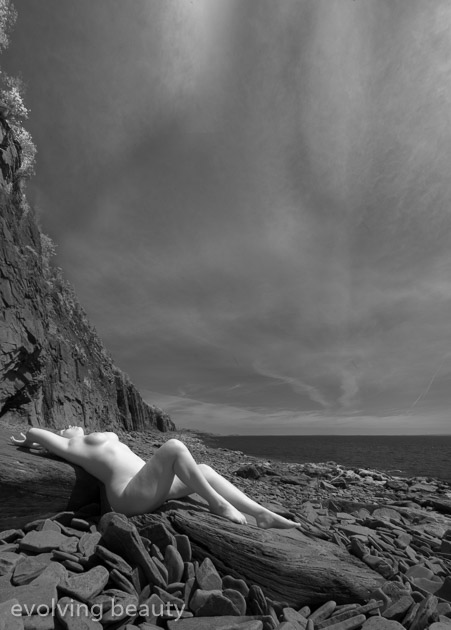
Digital infrared original, 4 frame stitch
This not only marked an opportunity to work with figure models in New Brunswick, but also to try out my newly received infrared sensitive Nikon D70. While I had tested this camera extensively over the previous week or so, I hadn't had the chance to make any nude images with the camera; I was quite looking forward to the opportunity.

Usually, with first time models, I prefer to head to a space in which I've already worked so the only new variable is the model. In this case, we headed for the best space I know of in New Brunswick - Cape Enrage. When I'd first worked there with models in 2004, I was totally amazed at the rich variety of possibilities and knew immediately it would become a frequently utilized location.
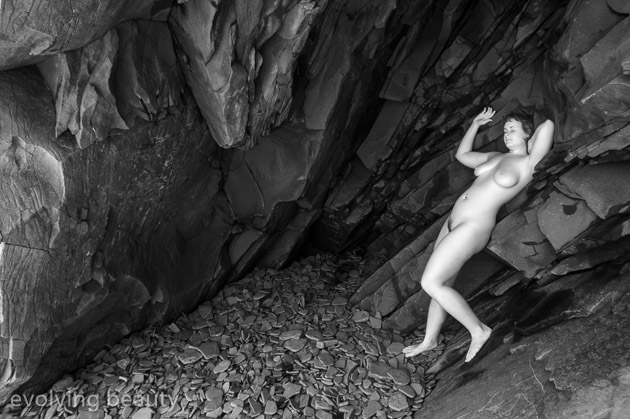
Digital infrared original, 6 frame resolution blend
The afternoon during which we had the opportunity to work coordinated well with the tide; we'd arrived with the full 10 metre height of the tide receded but with less than ideal light - the sky was big and blue and the sun beat down upon us, giving a harsh, contrasty light to the shoreline. I dealt with this in two ways - either working with the models under the sun and always keeping the compositions focusing on the lines of the body created by the sun, or by working in the shallow sea caves the ocean had carved out of the cliff-face, where the light was soft and even.

As has happened before, I found the embarrassment of riches represented by having three models available to work with somewhat distracting. Over the session I purposely rotated through the three models, working with the first, then adding a second for a set of images, then working with the second exclusively, then adding a third. The process seemed the only logical way to be fair to all involved, but at the same time, injected artificiality into the session that seemed to interrupt the natural flow of things.
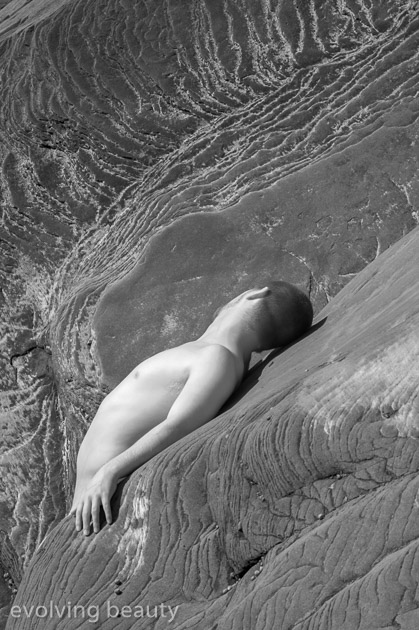
Digital infrared original
This is not to suggest for a moment that I'd rather have had fewer models along for the session, or that things should have gone differently but more that, in addition to the elements that usually go into an image (light, setting, lens, model), there was an additional consideration of. which model or models to use. With models that I know better, I'd have an idea of who to work with for each particular setting but, for this session, I was focusing more on making the best images of each of the three models, as opposed to making the best image for each setting, which would be a very different process.