June 13, 2005

A Walk Through Sackville, New Brunswick


Digital original
Just as I discovered when I started working with digital cameras in 2003, one thing that the infrared-modified Nikon D70 is encouraging in my work is the simple process of photographing for the joy of it. Often I find myself making an image just to see how it would look with the infrared camera. This is particularly advantageous at this point, as I am still learning how to use the camera, make good exposures, and generally overcome some of its quirks. Unlike traditional DSLR cameras, there is little documentation for infrared modified bodies, so there is a lot of experimentation and testing involved in the process of learning the new camera.
Digital original
That being said, many of the experiments I have been making have resulted in interesting photographs in their own right. One unexpected side effect of the infrared conversion is that most images created with the camera appear as near monochrome photographs on the post-view LCD screen on the back of the camera (this is because the image is made with a custom white balance, which almost totally negates the strong red cast of the infrared image under normal camera settings). This essentially means that I get to post-view each exposure in black and white, and get a much better sense of how the subject is being rendered in black and white. When I was working with my first infrared modified DSLR, a Sigma SD10, the images were all deep red on the LCD, so this added advantage to the modified Nikon D70 was quite unexpected.
Digital original

June 12, 2005

A First Session with Lis

Lis first contacted me in February about modeling. Given her location in Toronto, Ontario 1,200 km to the west of Moncton, I didn't expect to actually have a chance to work with her as I wasn't expecting to be in Toronto in the foreseeable future..
Digital infrared original, 3 frame stitch

Early in June, however, I received an e-mail asking if some dates later on in the month would work for me, and less than two weeks later I was waiting at the Moncton airport, looking for someone I'd never met (or even seen a photo of) before. Less than an hour later, Lis and I had the living room of my house set up and were working on our first set of images.
Digital infrared original
As Lis was only visiting for an afternoon and evening, we decided to work in two sessions, the first with available light. The day had bright skies and few clouds, giving us relatively bright illumination from the sheet-covered windows.
Digital infrared original, 9 frame stitch
A session with a new model is always full of unknown possibilities. When working with someone I've photographed before, often I can anticipate how the images will look, or what the outcome will be like, as I can draw upon the work we've previously created. With someone whom I've never worked with before (or in this case, never even met previously), there is always an open end to the possibilities. That is the real magic of working with new models.
Digital infrared original
As with almost every first session, I began with portraits of Liz, simply asking her to flop on the white sheets and make herself comfortable. The portraits remained the focus for most of the session, with only the occasional foray into working with full body poses, either lying on her side, or from the back on; generally working indoors precludes full body poses, simply because there often isn't enough room for the composition. After a couple of hours of working, we both felt we'd made the most of the time and light, and packed up the available light studio to prepare for a studio water session.

June 11, 2005

Gray's Island

After several hours of photography Genevieve, Tom and Kayla at Cape Enrage, we wrapped up the session and headed back to Moncton. On the way, however, we took a detour to Gray's Island, a small tree-enshrouded hillock beside the Peticodiac River, about 25km south of Moncton. In the centre of this former island is a graveyard, including one of the best known graves in the area, the "haunted" grave of Miss Steeves. This is one of the few graves I have ever seen in the Maritimes with a statue of the deceased on it.
Digital infrared original
The infrared modified Nikon D70 worked well in the graveyard, giving the images of the graves a eerie, dramatic look that suited the subject matter. I was a little disappointed in the performance of the 12-24mm Nikkor lens, as the images were a little soft in the corners (this ends up to be a side-effect of the infrared conversion, not a problem with the lens), but the camera performed exactly as I had hoped it would, giving very similar results to what Kodak's HIE would have produced.
Digital infrared original

The final composition of the day came further along on the drive back to Moncton, when we passed some flowering fruit trees by the road. I was unsure how the blossoms would render on the infrared sensory, so I nipped out of the car and made several different exposures of the tree. By this point the morning's clear blue sky had developed a number of high, wispy clouds that provided a wonderful background to the white drama of the tree.
Digital infrared original
On the whole, the day was wonderful start to an exploration of a new tool. In addition to making some very strong new images, I learned much about my new camera and have moved closer to being able to fully anticipate how the results from the small LCD screen on the back of the camera will translate into the final image, which is a huge advantage over the more traditional infrared approach of using expensive film and bracketing the exposures to try to insure a quality image.

Three Models at Cape Enrage

My first exhibition in New Brunswick, a show of water abstracts and nudes called "Aquis" was held in June in a small cafe in Moncton, where I live. At the opening, Genevieve, who has modeled for me previously, brought friends, Kayla and Tom, who expressed interest in modeling. So not four days later, the four of us set out for a day of photography.
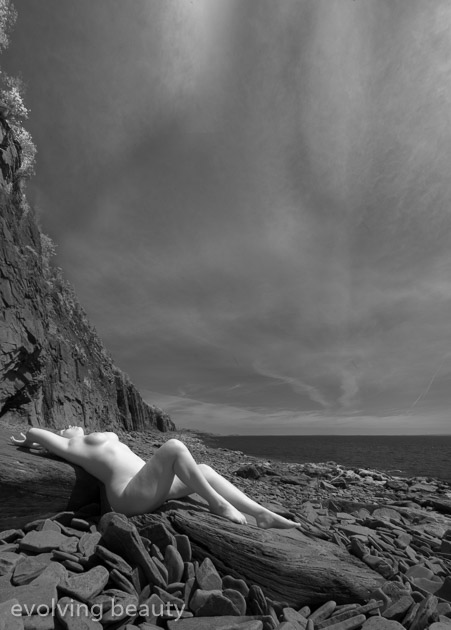
Digital infrared original, 4 frame stitch
This not only marked an opportunity to work with figure models in New Brunswick, but also to try out my newly received infrared sensitive Nikon D70. While I had tested this camera extensively over the previous week or so, I hadn't had the chance to make any nude images with the camera; I was quite looking forward to the opportunity.

Usually, with first time models, I prefer to head to a space in which I've already worked so the only new variable is the model. In this case, we headed for the best space I know of in New Brunswick - Cape Enrage. When I'd first worked there with models in 2004, I was totally amazed at the rich variety of possibilities and knew immediately it would become a frequently utilized location.
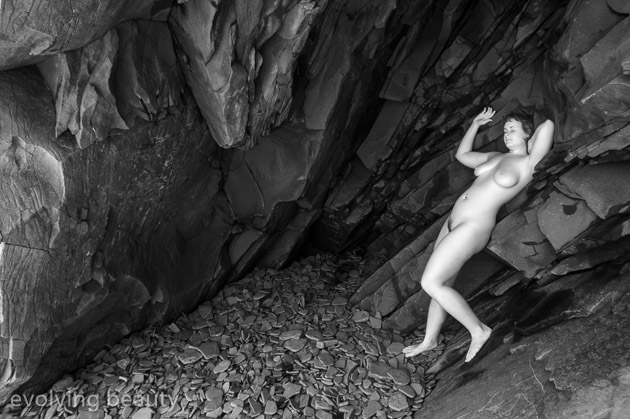
Digital infrared original, 6 frame resolution blend
The afternoon during which we had the opportunity to work coordinated well with the tide; we'd arrived with the full 10 metre height of the tide receded but with less than ideal light - the sky was big and blue and the sun beat down upon us, giving a harsh, contrasty light to the shoreline. I dealt with this in two ways - either working with the models under the sun and always keeping the compositions focusing on the lines of the body created by the sun, or by working in the shallow sea caves the ocean had carved out of the cliff-face, where the light was soft and even.

As has happened before, I found the embarrassment of riches represented by having three models available to work with somewhat distracting. Over the session I purposely rotated through the three models, working with the first, then adding a second for a set of images, then working with the second exclusively, then adding a third. The process seemed the only logical way to be fair to all involved, but at the same time, injected artificiality into the session that seemed to interrupt the natural flow of things.
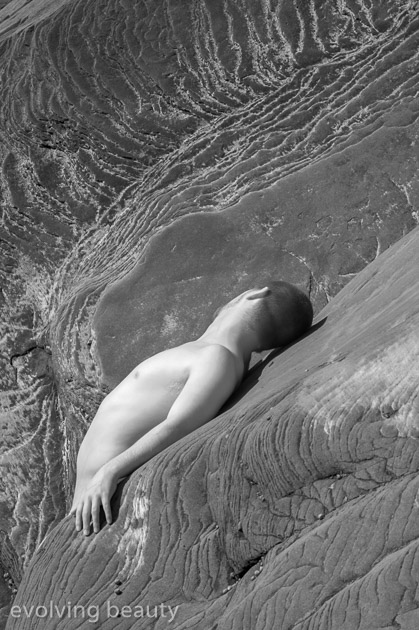
Digital infrared original
This is not to suggest for a moment that I'd rather have had fewer models along for the session, or that things should have gone differently but more that, in addition to the elements that usually go into an image (light, setting, lens, model), there was an additional consideration of. which model or models to use. With models that I know better, I'd have an idea of who to work with for each particular setting but, for this session, I was focusing more on making the best images of each of the three models, as opposed to making the best image for each setting, which would be a very different process.

May 29, 2005

Flowers in the Rain

I have always been fascinated with macro photography, but given my predilection for photographing architecture and the Nude, I don't have many opportunities to explore close-up photography. With the weather being as horrible as it has of late (rain, rain and more rain seems to be the order of the days and weeks), I spent today working with a number of photographers in downtown Moncton, and testing the Olympus 50mm f/2 macro lens. My partner Joy bought an Olympus E-300 this spring, and the 50m f/2 lens would be a perfect addition to her system - both as a fast portrait lens and a good close-up lens.
Digital original
Though the day was heavily overcast, with rain spitting intermittently, and threatening a real downpour, we decided to head as a group downtown, to see what we could find to photograph. With the macro lens in hand, I was specifically looking for small things to photograph, and these little white flowers, covered with water drops from the morning's rain, seemed just perfect. The macro lens on the Olympus E300, combined with a flexible tripod and wireless remote, made the whole process simple and straightforward.
Digital original
As it happened, one of the other photographers had the extension tube for the 4/3rds system, so I was able to focus REALLY close with the macro lens - a total revelation. Once I'd set up the lens with the extension tube, I worked alternately between compositions that called for a deep depth of field, and those which would be more appropriate for less in focus. Close-focused images inherently have less in focus, but sometimes, more in focus, as opposed to less, is preferable.
Digital original
The explorations of the water-dropped flowers came to an abrupt halt as the sky opened above us and the real rain started. As nice as the flowers were, they weren't worth ruining any camera equipment.

All I can think of now is how much I want to work with rain-covered flowers again!

May 14, 2005

A Day of Exploration

Usually by mid-May, the weather is more than warm enough to be working outdoors with models, but this year's spring has been unusually cool. As a result, the first weekend that I'd intended to spend working with models in New Brunswick was spent driving around on the Nova Scotia-New Brunswick border looking for potential spaces to work in with models, photographing, and generally having fun.
Digital original
The first space to really engage me was a massive stone bridge Joy found in the middle of the small community of Tidnish; in the midst of an innocuous looking park, the path went over a broad, wide bridge. In a country well under 150 years old, stone bridges of this sort are incredibly uncommon, and it wasn't until I was back home hours later that I could discover its origins - it was originally built to support a ship railway, for carrying ships from upper Canada across the Tantramar mashes, and into the Bay of Fundy, saving over 500 miles of sailing. The project ultimately failed, but the remains, like this massive stone bridge, are a mute testament to the grand effort that was undertaken.
Digital original, 2 frame stitch
After leaving Tidnish, I spent the rest of the afternoon driving along back roads, and keeping an eye out for potential spaces to photograph. About the only thing to bring me to a halt was a single lone tree on the horizon of a distant field. The afternoon sky was high and multi-layered, providing a simple but visually engaging setting against which to place the tree.
Digital original
The last hour or so of the day's trip was spent photographing the architecture in downtown Amherst, the last town in Nova Scotia before the New Brunswick border. This was the first time in the day that regretted not having my 8"x10" view camera with me. Architecture naturally lends itself to the flexibility and control of the large format camera, but as the day was simply an exploratory mission, I had left it at home. In an effort to make the most of the situation, I decided to focus on architectural details and images where colour was a major element.

May 08, 2005

Three Models in the Studio

The original plan for this afternoon was to head to the countryside with Natasha and work in the landscape for the remaining light of the day. As things turned out though, the rain precluded that plan, so after some quick phone calls, and a somewhat hurried lunch, Natasha joined Ashley, Miles and I in the studio for an impromptu three-model session.
Digital original
I've worked in the studio with three models in the past (the most notable time being the "Three Graces" session in 2002), but each time it has been a planned session, with some foresight put into the possibilities and direction of the sessions. For this session, given that Ashley and Miles had only modeled together for the first time hours earlier, and Natasha had never met either of the others before lunchtime, it was a little more awkward at the beginning. Fortunately, I'd left the studio set up from the earlier session, so we could begin where the comfort seemed to be the highest, with the models simply lying comfortably on the backdrop.
Digital original
For the remainder of the session, I alternated between the various combinations and permutations possible with three models (1+2+3, 1+2, 1+3, 2+3), often working with very similar poses with alternating models, to make the most of the possibilities. To a degree, it was harder to work with the two women and Miles together than with any other combination, as it was a little difficult to keep the images from looking too hedonistic, but with careful attention, and a focus on a more stylistic approach, the results were very pleasing.
Digital original
In the end, for all that the day was cold and wet, with the help of the enthusiastic models I was able to make some very striking images. For all that I was hyper-aware of the potential issues of placing two, and then three models, in such a personal and intimate setting, the day's sessions couldn't

Miles and Ashley Pose Together in the Studio

Sunday in Halifax was blustery, wet and cold; instead of working outdoors as I had hoped, I stayed inside for the day, working in a studio for both the morning and afternoon sessions.
Digital original
When planning ahead for this visit to Halifax, I'd arranged to work with Miles and Ashley on Sunday morning. Ashley had modeled nude previously for Miles but, after seeing my work, specifically my work with couples, was interested in modeling for me with a male model. Miles was an obvious candidate as he's worked with me for more than eight years and has several times cheerfully posed with models who were not partners.

Working with two models who are not a couple is always an interesting (and on some levels, delicate) process. Much of the tone of a session is set by the models' comfort; while one can assume the comfort level of a couple, when two friend or acquaintances model, there's no way to predict how relaxed or awkward the session will be.
Digital original, 5 frame stitch
With Ashley and Miles, it didn't take long for the models to find their own comfort level and simply focus on making the images. For the first while I worked with the models standing, but the awkwardness this introduced was hard to overcome. With "real" couples, standing poses inevitably turn into cuddlefests, but with Ashley and Miles, as much as they worked with embraces and hugging, the images had an artificiality to them which is impossible to ignore.
Digital original, 4 frame stitch
The second half of the session was much more successful, with the models shifting to work on the floor, and the lighting shifting to a more dramatic, side lighting. By this time, there was little hesitation or uncertainty in the models' movements, and that, combined with the more relaxed, prone poses, really strengthened the closing images of the session.

May 07, 2005

L_ Dancing

L_ recently returned from a long trip to Turkey and India. Shortly after getting back to Halifax, she asked if I'd be interested in photographing her in some of the belly dancing costumes she'd bought during her trip. I was more than happy to to help and we made plans to spend an evening in the studio during my next Halifax visit.
Digital original
I was quite surprised by how different working with clothed models is (I suppose this should come as no surprise, but, as I'd never thought about it, it was worth mentioning). With the focus being on the dance costumes, I had to alter my usual approach to working, and experiment more with pose and position than lighting. As it happened, L_ forgot to bring dance music so she had to work harder to create a natural flow to her body and the costumes.
Digital original
As the session was so focused on the costumes and poses, I lit the studio as evenly as possible, which had the added advantage of using all the flash heads available to me. This resulted in my being able to set the lights to their lowest setting, permitting me to photograph L_ dancing at three frames per second!
Digital original

This session, more than any other recently, brought home the huge influence that digital cameras have had on my approach to photography. Because so many of the images were of L_ in motion, I took advantage of the high volume of images possible with digital SLR cameras. By the end of the session, we'd recorded more than 1,100 photographs and, while many of these were discarded (due to facial express problems, bad timing, or bad framing) the images I kept were much stronger for the high volume used to create them. The other element that digital photography added to the session was that less than two hours after finishing the session, L_ and I parted ways - her with a DVD full of images, and me with the satisfaction that I'd been able to go from start to finish with the session in under five hours!

May 06, 2005

Miranda and Partner

With the warmer weather in May comes the beginning of the photo workshop season and the resumption of my regular visits to Halifax. I was lucky on this visit, in that Miranda's work schedule permitted us some time to work together on the day I'd arrived (we'd planned to work later in the weekend too, but scheduling issues conspired against us). The day was too cool to permit working outdoors but fortunately one of the upstairs rooms was available to work in (the same room where I'd worked with Gilda, Ingrid and Miranda on New Year's Day).
Digital infrared original

As I move closer to converting the Nikon D70 permanently to infra-red, I decided to do a test with an infrared opaque filter - the results were quite pleasing - this image of Miranda was made by soft diffused light - I pushed the ISO up, and used a fast f/1.4 lens, but the results were more than acceptable. If this is an indication of what I will get with the converted camera, I am very much looking forward to using it.
Digital original

With my previous DSLR, the Canon 10D, infrared photography wasn't practical; the camera was both very insensitive to infrared light and many of the images had a huge hot-spot in the centre of the image, making the results basically useless. The Nikon, on the other hand, worked quite well - the camera was quite insensitive to infrared light, but the results were quite lovely with no hot-spot to be seen. I made a number of images of Miranda standing against an open door, drawn to the small white door handle - the only real problem being getting accurate focus.Infrared light focuses behind visible light and requires adjustments to focus for larger apertures.

The rest of the session was spent working with Miranda on the bed, lit by the window behind it. The experiments with the infrared filter at the start of the session had been focused on standing poses, so I thought working with sitting and reclining poses would add some variety. In the middle of the session, Miranda's partner leant his arms and torso to a number of images, adding a third layer of variety.
Digital original, 5 frame stitch

By the end of the afternoon, the light was fading, and I had to take my leave to set up for teaching. The experiment with the infrared filter had made me even more enthusiastic for the modification of the camera, and the variety of images, from working with the door, Miranda and her partner, and just reclining on the bed, made me feel like we'd made the most of the time we'd had.