March 09, 2004

A Session with a Local Model

Without a doubt, the biggest impact of the move to Moncton on my work is the fact that most of the models and locations I have worked are now a three-hour drive away. This is mitigated somewhat with the fact that over the spring and summer, I'll be in Halifax on a monthly basis, but it does mean that much of the coming year will be dedicated to discovering new models and locations.
8"x10" film
My first session with a local model was last fall, when I worked with Lindsay; (I hope to continue working with him outdoors, once the weather warms up), but it was only recently that a second local model, Genevieve, was able to come by to work. As the winter months drag on, the the days start to lengthen, I am starting to get itchy to work outdoors, and tied to that is the hope to find new models to work with.

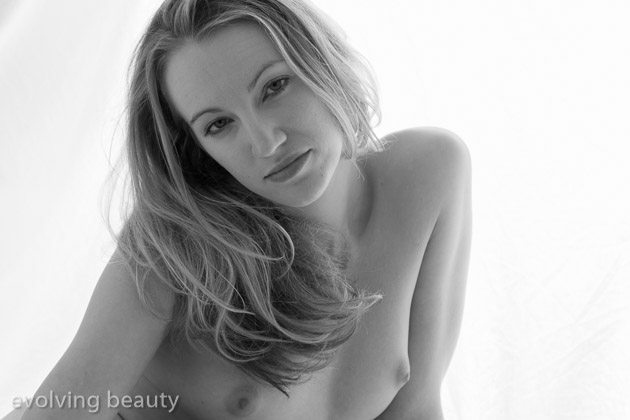
Genevieve's interest in working with me is born in part in her own artwork, which work a lot with the female nude; also, in the past, she'd modeled for a local artist, so she already was quite comfortable with modeling nude. Though we started the session later in the morning, the light in the kitchen was till good enough to work by, so we set up the futon and started to work. Because of the time, the light was totally diffused by the time it hit the white sheets, so my usually strong back-lit images were more subdued than normal.
Digital original
On the whole, the session went well, but I was frustrated by the light and the large amount of work I have already produced indoors this winter; numerous times I would frame up and image, or suggest a pose only to find that it too closely mirrored earlier work with Kylie or Miranda. In the end, after making a couple of very strong horizontal images of Genevieve using the 8"x10" camera, I called the session to an end, content with the couple of images I felt were strong and frustrated by the limited space and diminished light.

March 08, 2004

Kylie on a Sunday Morning

Given how many sessions Kylie and I have done indoors, it would be fair to expect us to begin to run out of ideas and poses - and so I thought. As winter comes to a close and the days grow lighter and warmer, the itch to move outdoors and resume my work with the nude in landscape grows, but it will still be a month or two before that is possible, so I have to content myself with what can be done indoors. 
Digital original
For this session, rather than recreate the same space that Kylie had already worked in before (both the previous day, and in January), we decided to work with just the window, and a chair. Initially, I had reservation about this, as I shy away from using props in my images, preferring to just work with the figure alone, but short of returning to the sheet-covered futon, or working with standing poses (which we had worked with extensively the previous two sessions), it seemed the best option.
Digital original
As it turned out, the chair was a fabulous focal point for the session; Kylie responded well to it and, over the session the chair gradually spun in a full circle, with her working with every side of it and the two of us exploring the possibilities. My initial hesitation about using the chair proved groundless, as the session was firmly focused on Kylie's body and face as the subject; though present in almost every image, the chair simply becomes part of the background setting,a nd isn't distracting or jarring in any of the compositions.
Digital original
Probably the most pleasing element of the session was how spontaneously Kylie found poses - usually it can take a bit of experimentation before a session really takes off and hits its stride but this session, pretty much from the first image Kylie and I were making engaging images that took advantage of both the beautiful light and the strong poses. After the previous evening's session, where I was changing the lighting often, and focusing as much on that as the pose and composition, it seemed refreshingly simple to concentrate on the composition along - the lighting was as near to perfect as it can get, and the poses seemed to unfold in front of me, only occasionally requiring a suggestion to change them into striking photographs.

March 07, 2004

Kylie Returns to the Studio

Digital original

Because of how tight our schedules are, when Kylie did have time available to model, we made the most of it - three sessions in one day is not common; except when I was in Alberta with Victoria in 1999, I doubt I work three times in a day with a single model more then a couple of times a year. That being said, with access to three different settings/styles of work available, we took advantage of the possibilities.
Digital original
We started our studio session with an evolution of the semi-silhouette images I'd made with Miranda earlier; this time I was able to get closer to my intention. My first attempt with frustrated me because the background was too distinct because the flash was so bright and I needed to stop the lens down on the digital camera to a smaller aperture to compensate; this time I used a neutral density (ND) filter to reduce the depth of field. The final results were very pleasing, both from a technical perspective, with a better mix of shadows and light, and a more pleasing depth of field. I think I will continue to pursue this idea, as between the images of Miranda and this session with Kylie, I have made a number of images of this type that really jump out at me.
Digital original
Once we finished working with the painted backdrop and the strong side lighting, I changed the room around to a more traditional set-up (for me, at least), with the black backdrop and my single light to the front, providing a pleasing light for portraiture. Again, having only a single flash-head to work with was somewhat limiting but by the same token, my usual frustration with studio work was somewhat mitigated by the simplicity of the set-up - with a single light, there are only so many options.

Another Session with Kylie

After spending the morning working with white sheets and my kitchen light, we shifted our location to a friend's apartment and resumed working. This time, we were working with black cloth as the background. After several years of focusing my available light work on working with white sheets, I decided at the end of 2003 to purchase a large black sheet and see what would come from shifting the background from white to black.
8"x10" film
We started working with Kylie standing in front of the backdrop, with the large picture window and a reflector providing the light. The end result looked much like our earlier studio flash images but the process was very different; whereas in the studio I feel compelled to adjust the lighting for each and every image, with the natural light, I just worked with the pose and composition. This leads to the creation of images in a much more spontaneous manner than I would have done with the same pose in a studio; overall, while the look speaks of a lighting studio, the process of making the images was much closer to the way I prefer working.
Digital original
Once we exhausted the possibilities offered by standing poses in front of the backdrop, we shifted to working with Kylie on the floor, with the black sheet as the cover for the carpet. We began working with the digital camera, making a series of images based upon some rather extreme stretches. In a pause between these poses, Kylie relaxed, and, quite spontaneously, a striking portrait was born. I asked her if she could hold the pose and quickly (well, in 5 minutes or so which is rapid for large format) set up the 8"x10" view camera to make the image. The difference between working with the digital camera, where I could respond to a pose intuitively and swiftly, and using the view camera, where even a small composition change takes a fair amount of effort to make, was incredible. I enjoy working with the digital camera and have made many a successful image with it, but every time I pause the process, and switch to the view camera, I find myself reveling in the flexibility, clarity and control of the larger format film camera.
Digital original, 6 frame stitch
The session wrapped up with Kylie working against the same wall that yielded one of my favorite images of the year to date; this time, instead of having strong directional light, we were working with a softer light - the day was overcast, and direct sunlight was only fleeting, when it existed at all. As I'd learned with her the first time we'd worked in the apartment, Kylie has a particular skill for making the most minimal setting work for her - probably a side-effect of how strong a gaze she has. Very different from a model like Elisabeth, who has the classical "captivating gaze", but time and time again, it is Kylie's face which forms the centre of an image.

Kylie Returns to Moncton

Digital original
After my first sessions with Kylie in January were over, and all the images were processed and edited, I was very much looking forward to working with her again; her comfort with modeling clearly showed in the images and her enthusiasm for the entire process was a close mirror of my own - always a good thing! Time passed, and life got busy, but finally after eight weeks, it happened that our schedules coincided and she returned to continue working where we'd left off.
Digital original
We began with a session using the available light in the kitchen, the futon and sheets; as the year warms up, the light is slowly shifting back to shining directly through the deck doors, which is only going to increase the functionality of the space. This being said, by the time we actually got the room set up and ready to work, the last of the sun had moved to the side, and we were left with indirect light - bright enough to work with, but lacking the white brilliance of direct sunlight. This actually doesn't show up much in the images but it did have an influence in the kinds of images I could make - the lower light levels forced longer exposures, so while I continually returned to working with portraits, most of the images focused on reclining images, working with Kylie lying on her back or front, and using the back-lighting of the white sheets to light her figure.
Digital original
The entire tone of the session was different from those in January - then the main focus of the session were to introduce Kylie to working with me and create images that would gain her confidence. With this session, I was able to concentrate more on what I was seeking and made a number of images that pushed; one of the advantages of working with a model multiple times is that it is easier to make experiments and take risks without risking the relationship with a model - a couple of failed experiments here and there can often pale in the face of the successes (or so I hope).

February 15, 2004

Sara in the Shower

The last session of my February visit to Halifax was a short one, working with a new model, Sara, in a shower. Since I moved from Halifax to Moncton, I hadn't expected to do any more shower nudes, as the beautifully lit shower in my old house was replaced in the new one by a corner stall. What made the shower at my old house so perfect to work in was the fact it was lit by a skylight - as long as the day was remotely light, I could work in the shower with beautifully even light, coming from the skylight.
Digital original
Photographing a model in a shower has some built-in technical issues. Working close to running water is always a concern, due to how much electronics are in modern cameras. The only answer to this is due caution - during the session, occasionally I felt the sprinkle of water on my hands, which caused me immediately to pull back and change my position. One way to keep this problem to a minimum is to angle the flow of the shower away from the camera angle as much as possible - as long as some water is striking the model, they will stay water-covered, and the camera will be sheltered from most of the water.
Digital original
The second technical issue has to do with all the steam and humidity in the air - the hotter the shower, the more pleasant it is for the model, but the more chance there is for condensation to build up on a camera's lens. The only way to overcome this is to keep an eye on the contrast of the image in the viewfinder (the image will drop in contrast as condensation builds up) and move the camera out of the bathroom to let the condensation evaporate. This is of course, assuming you wish to avoid the effect - for this session, with several images, I let the condensation stay, and ended up with some very dreamy results. Not necessarily better then they would have been otherwise, but successful in their own ways.
Digital original
Whenever you combine a Nude with water (in a shower or river), you add an extra layer of complexity to the image - light that is usually soft and subdued becomes specular and reflects off the water where it would normally just softly edge light. The results from the end of this session point out how much water can influence an image - when Sara lent back into the shower, and had water running over her torso, the light from the window picked up all the highlights on her body, and made them leap out of what would have otherwise been a subdued image.

February 14, 2004

Miranda Models on Valentine's Day

Something that I have become more and more aware of is how much my own images influence where my work heads. As a younger photographer, I often used other people's images as inspiration, working with an idea they had and molding it into my own. Now however, what is far more common is making an image, and then a day, a week or a month later, making a second image that takes the same basic elements of the first images, and pushes them further. I suspect this has always happened in my work but I have been increasingly conscious of it in the past year or so.
8"x10" film
When Miranda showed me the corner of her room she had cleared for us to work in, I immediately thought of an image I'd made a month earlier with Kylie, standing against a bare wall. When I'd framed up that composition, I'd worried a little that the figure would seem to small in the image and be lost to the emptiness around it. To the contrary, that image turned out to be one of my favorites and as soon as I saw the white bed, pillows, walls and ceiling, I immediately sought out compositions that would take advantage of the same sense of open space that worked so well with Kylie. The end result was a very different image for me in that it relies upon delicate white tones as opposed to dark shadows to describe the space, but it still has the "small figure in a large room" feeling that was so surprising with the initial image.
8"x10" film
In contrast to our work in Moncton, the indoor session with Miranda in Halifax was wholly back to my tradition of working with available light. Lit by a single pair of windows, much of the bed was in a soft shadow, which made it very different to work with from the white sheets I usually employ. For most of the images, as opposed to shooting into the light, I worked beside the window, with the light flooding across the bed - in contrast, when I work with white sheets, I shoot directly towards the light, using the back-lighting to provide edge lighting to the Nude.
Digital original
Miranda and I worked through much of the afternoon, with the session drawing to a close only when the setting sun stopped striking the room windows directly (because we were working to the side of the window, when this happened, the light level dropped dramatically). I was pleasantly surprised with the mix of 8"x10" work, and digital images; usually indoor images tend to focus on one or the other but with the even light, I was able to rate the HP5+ film I use in the view camera at 800 ISO, giving me a little speed with which to work (as the contrast of light goes down, with black and white film you can increase the effective ISO, and compensate for the speed increase in the darkroom - with a digital camera, unfortunately it doesn't work the same way). When I'd first seen the space in which we were going to work, I had thought it would be a totally digital session...much to my surprise it was much more balanced between the two camera formats.

February 02, 2004

Miranda Models at the NBCC

The reason that Miranda's visit in January-February was perfectly timed was the fact that I had be invited to present on my work to the New Brunswick Craft College photo program; when I'd initially been approached, I was asked if, in addition to presenting my work and discussing the process, I could provide a demonstration of my working technique. While I wasn't opposed to the idea, I did have serious concerns about whom I'd arrange to work with me in such a "public" manner; the school offered to provide me with one of their regular figure models. This would have been less than ideal because a major part of how I work is the relationship I establish with the people I photograph; the idea of demonstrating my approach with a model I would have just met was daunting, not to mention contradictive.
Digital original
As it turned out, Miranda was coming up to Moncton the weekend before I was to present and she agreed to stay an extra day to travel up to Fredericton to work with me during the class presentation.

It can be an awkward thing to photograph with the purpose of illustration and education, as opposed to creating a final image.Fortunately, both Miranda and I have worked in similar situations before (though not together), so we managed to not only guide the students through my particular way of working but also make several striking images. The first came as I was trying to guide the students through the process of recording an initial perception through to fruition using the digital camera and the second came at the very end of the session, when I made a portrait with the 8"x10" view camera as a demonstration of working with the larger format.
8"x10" film
In the end, as much as the session was a class demonstration, I came out of it pleased with the images as much as the presentation. Miranda saved me from the difficult possibility of providing a demonstration of my work in a most a-typical way (working with a model who was not already familiar with my approach) and helped me make several images that built upon the images we made over the previous days.

Miranda in Morning Light

I am always surprised at how successful short sessions can be; in the past I have had sessions that lasted no more than 30 minutes yet yielded very striking images. With this session, squished in between waking up and driving to Fredericton, I was very keen to make the most of Miranda's time while she was visiting and even more enthusiastic about being able to work with available light after so many sessions using the studio flash which, while it is a good response to the reality of living and working in Canada, is not natural light which I have a strong affinity for, and by far prefer to use when I can.
Digital original, 12 frame stitch
Because so many of my recent sessions have been working with models on the white sheets, I decided to change the approach a little and, as opposed to having Miranda on the sheets, I asked her to work as if she was emerging from them. In some ways this is related to much older work of mine, with Lisa in Maine, but where those images were "genuine" (Lisa was chilled from working outdoors, and was huddled under the sheets to keep warm), this session was using the sheets as an aesthetic and compositional device. We didn't have much time, so we worked with a single basic pose, and I explored the possibilities of various compositions and variations.

February 01, 2004

Miranda's Second Studio Session

The second studio session with Miranda was a little more focused than the first; for one thing, it was better timed, being at the second day of her visit, as opposed to only hours after her arrival and I worked with a more traditional approach. I decided to further push the boundaries of what my new studio flash could do and see how close to mimicking my approach with natural light I could come indoors at night.
Digital original
We started working with the flash located behind the white sheet, and Miranda on the other side of it, posing on a futon-bed.This is very similar to the way I work with natural light indoors but had a number of advantages. Often with natural light, there is not much light, so I have to use very narrow apertures to avoid movement from the model breathing (I will make images with natural light that use exposures of 1/4 second or longer). With the flash, while I was still working with relatively wide apertures (giving a narrow depth of field), I had no concerns about the length of the exposure, as the flash was going off at 1/2000 of a second!
Digitial original
It was surprisingly different working with the flash, as opposed to available light; for one thing, as much as I tried to mimic natural light with the flash, it was still quite different - the angle of the light was too distinct (it was too close to the backdrop) and the degree of the diffusion was not the same, probably because the rest of the room was in deep shadow. All that being said, it was distinctly different in look and feel from most of my recent studio work, making it a refreshing change, albeit different from my intent.
Digital original
In the end, the most engaging image I made was of Miranda sitting up and leaning back against the futon. I used a close composition to reduce her arms to graphical elements, and focused the image upon her knee, breast and hair. This image, so different from what I'd expected to produce, pleases me nonetheless. Sometimes the best images are the ones you never thought to make.