July 09, 2001

Cassandra, Nova Scotia X (Feltzen South, Nova Scotia)


35mm film
The close of the day was probably the most relaxing session for Cassandra of all the days we'd work together; while she reclined in a hot-tub, I photographed her, exploring the levels of distortion and reflection in the water, and later, while it was turned on, the total chaos of the bubbles in the water. It was next to impossible to pose Cassandra in the hot-tub, so most of the images simply consisted of the best composition and framing that I could manage in the moment.
35mm film
On the whole, over a full roll of colour images, only a couple were really successful; many failed because of the rapidly moving water, while others had Cassandra floating off the black fabric we used to hide the baby-blue colour of the tub shell. I think, with more preparation and consideration, very successful images would be possible in the hot-tub, but these images feel more like a first sketch then a finished vision of the space.

Cassandra, Nova Scotia IX (Feltzen South, Nova Scotia)

By the early afternoon, the fog had partially lifted, and, more importantly, the day had warmed enough for us to move to the coast and work with the blue-grey rocks on the opposite side of the peninsula from Rose Bay.
35mm infrared film
In contrast to the earlier session at Rose Bay, the work on this day went until the film ran out; the day stayed warm and pleasant, though the ever-present fog loomed on the horizon. The light, soft and delicate, provided beautiful description of Cassandra's form on the rocks, and in particular, the light was wonderful for the infrared work, where it gave a luminous glow to her skin, and the green-brown rockweed that abounds at the coast, giving it a fairytale-like luminescence unique to infra-read film.
8"x10" film
The most exciting image of the session, however, would be made with the 8"x10" camera. As we worked down the rock beach, I came across a sharp-sided ravine, which led down to the shore. I immediately asked Cassandra if she could lie in it, with her head and arms towards the camera, and her body flowing away from me. She tried to pose, and initially it didn't work - the way I'd envisioned it, Cassandra would have been on her back, which proved to be anatomically impossible. With some wriggling and careful adjustments, however, Cassandra managed to find a (somewhat) comfortable position, and things started to come together. Using my 159mm wide-angle lens (equal to about a 20mm on a 35mm camera) I carefully framed and focused the image, making the plane of focus follow the lines of Cassandra, as opposed to the rocks around her. The result is one of the strongest images of the project, and the first selected for Cassandra, the Nova Scotia Portfolio.
8"x10" film
This session was probably the most important of the entire project, both because of the strength of the work, and the improving confidence of Cassandra at working out poses. Since our first session, I've been encouraging her to put forward her own ideas for poses and images, to augment those I suggest, but it took several days for her to begin to do so confidently. The difference in the images was subtle, but definite, leading to our strongest session to date. Though I wouldn't see the film for another two weeks, I definitely felt a difference during this session.

Cassandra, Nova Scotia VIII (Feltzen South, Nova Scotia)

A consistent theme in the Cassandra work is fog; less in images, then in when and where the images were made. On this morning, the world around us was almost invisible, shrouded in a dense mist.
12"x20" film
Because it was foggy and cool, we opted to work indoors for the morning, permitting me the time and setting to begin working with a new camera format - a 12x20 camera owned by my friend, Jeff, and offered for use to me when time and circumstances permit. As we were going to work indoors anyways, I thought this was as good a time as any to try the new camera.
12"x20" film
 Because the film is so large, the camera needs very long lenses; for the indoor photos I was using a 360mm lens, which required a very small lens opening to ensure enough of the image would be in focus. As a result, the images I made of Cassandra on the couch were four seconds long; fortunately all I was asking of her was to lie still; if there had been anything more dynamic involved, I doubt that such a long exposure would have been possible.
8"x10" film
Because the large camera takes so much effort to use, we only made two images with it, the remainder of the morning being spent working with the 8"x10". After working with the 12x20, the Toyo seemed practically speedy to use, and it was quite enjoyable to move from a camera that was unfamiliar and somewhat daunting, back to one that has become very familiar and comfortable over my six months of use. I kept the same setting for the 8"x10" images, but as opposed to creating full body images, these were portraits and partial-body nudes. Whereas in my outdoor work I seldom crop the figure, indoors, it is usually the case that I use the camera frame to crop the figure. It was the long, angular aspect ratio of the 12x20 camera that provoked me to create the nudes of Cassandra lying on the couch..

July 08, 2001

Cassandra, Nova Scotia VII (Feltzen South, Nova Scotia)

Most of the landscape I work with in Nova Scotia constitute a small number of places; without a car, I am often limited to where I can get to conveniently with friends and models. With Cassandra, however, we had a car for the full two weeks, and could access spaces much farther a field. In addition, we were based for the first week in Feltzen, an hour south of Halifax, which put us in a different geographical area all together.
6x9 cm film
Where most of the rock spaces around Halifax are granite, the coastal cliffs at Rose Bay, near Feltzen, are a colourful sedimentary rock, flowing vertically up from the shale beach. With strong striations in the rock, and rich textures, the space was perfect to work with, and held a wealth of opportunities.
6x9 cm infrared film
 We arrived mid-morning on a grey, overcast day with the sun only hinted at behind low fog and clouds. The quality of the light was near perfect, as it was bright but even; the only real problem was composing any images that included the white and featureless sky. Though we found the seaside air a little chilly, we held out hope that the day would warm as it progressed, and set to work.

Our optimism about the weather proved to be misplaced and by the middle of the session, we were taking long pauses for Cassandra to warm up; the red "model sweater" which Joy had bought several years before was used to great effect. Eventually, not wanting to lose shooting time, we shifted to setting up the pose and camera with Cassandra in the sweater, only removing it just before the exposure was made.
4"x54" film
Eventually, after several hours of work, the cold became too much, and we had to call the venture to a close before Cassandra felt victim to a less benevolent form of "exposure.". The experience reminded me of the snow Victoria and I woke to one morning in Alberta, in July of 1999; no matter how much planning is done in advance, one can never account for the weather. The images we made were strong, however, with a number of interesting compositions made which would not have been possible with the rockscapes more familiar to me. I thoroughly enjoyed the chance to explore a new space, and was grateful to Cassandra for being willing to tough it out through the chilling temperatures to make the images.

July 07, 2001

Cassandra, Nova Scotia VI (Feltzen South, Nova Scotia)

It was late in the afternoon before Cassandra and I ventured outside, to work with the angular light of the setting sun. We walked down to the shore behind the house in which we were staying, and began to explore the possibilities of the rocky beach.
6x7 cm film
Unlike the work of the day before, most of the images we made at Back Bay were composed around the landscape; I worked primarily with Cassandra's form as a mirror or counterfoil to the landscape in which she moved. The low angle of the sun provided perfect lighting for the session, giving rich description to both the landscape, and the body within it.
35mm infrared film
My usual way of working with landscape poses is to give the model a sense of what is drawing my eye to a scene, and then ask her to explore the space physically with that in mind, and see what happens. Where the previous day's images focused mainly upon the movement of water, this session incorporated the rocks and foliage of the shoreline, which put a stronger focus upon the posing and positioning the body. For a new model, it can be hard work to make an image come together for the camera, and Cassandra put a lot of effort into making the poses work. As much direction as I can give from behind the camera, it is really up to the model to pull things together, as they are actually in the space, and know what is physically possible. An important part of working with a new model is to strike the right balance between directing the pose and encouraging the model to work with the space, developing a trust in their own body instinct.
8"x10" film
Over the session, I again mixed the landscape nudes with portraits, partially because the landscape was a little less engaging then I'd hoped for, and partially because of the simple power of the naked gaze. Working with all three formats (colour, 35mm B&W infrared and 8"x10" B&W) went well, with each being called into play when appropriate. The pacing of the session was great, with Cassandra and I moving down the beach as the images came and went, and eventually calling it a day when the sun sank below the horizon.

Cassandra, Nova Scotia V (Feltzen South, Nova Scotia)

This morning dawned cool, bright and sunny; less then ideal weather for working in the great outdoors. Fortunately the day before we'd discovered a wonderful ram's skull (in the collection of my friend and host, Jeff), and both Cassandra and I were keen to explore the possibilities of combining the skull with the Nude (as I had done two years before with Victoria in Alberta).
35mm infrared film
I began the work with the skull with Cassandra sitting in a chair covered in a black cloth; I knew that her skin and the bone would work really well against the black, and also felt that it would be easier to strike poses with Cassandra lying comfortably. This worked well for a number of image made both on the 4"x5" and the 8"x10", but quickly I realized that the body and the skull both were too cramped on the small chair, so we shifted to a standing space, lit by the sun coming through the large windows and deck doors. With some careful arrangements of reflectors, cloth backdrops (held by my friend Jeff) and model., we managed to minimize the distractions, and bring the images to bear fully on Cassandra and the skull.
8"x10" film
The compositions based on the skull and Nude were surprisingly easy to find - I suspect this is due to the natural form of the skull, but also, I think its form resonates in a person's mind, and pulls at something primal. Regardless of the reason for it though, the end result is striking, with the sweeping horns of the Ram leading the eye into Cassandra's pelvis, to rest upon the stark skull set against her bare skin. With all the machinations we went through to create the image, I found myself longing, like I had in Alberta, for a lighting studio to work with the body and skull in. That wasn't an option, however, and all things considered, I am very pleased with the results.
8"x10" film
The session came to a close with me setting aside the skull, and making a number of portraits of Cassandra, again lying on the couch. The strongest image, among my favourite of the many portraits I did of her over the two week, was framed so tightly as to show almost nothing but Cassandra. Taking the full advantage of the 8"x10", the image has only one narrow plane of focus, with her eyebrows tack sharp, and most of the remainder of the image delicately defocused.

Cassandra, Nova Scotia IV (Kejimkujik , Nova Scotia)

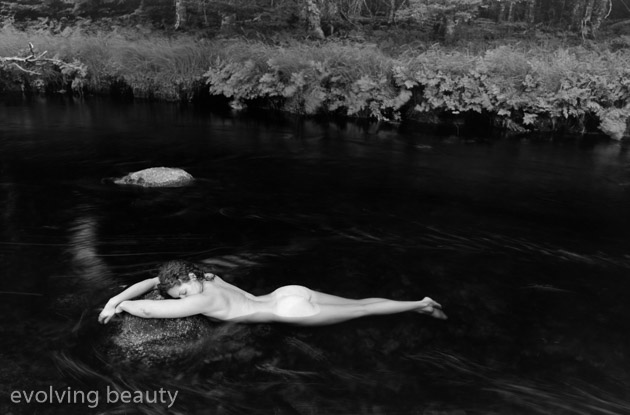
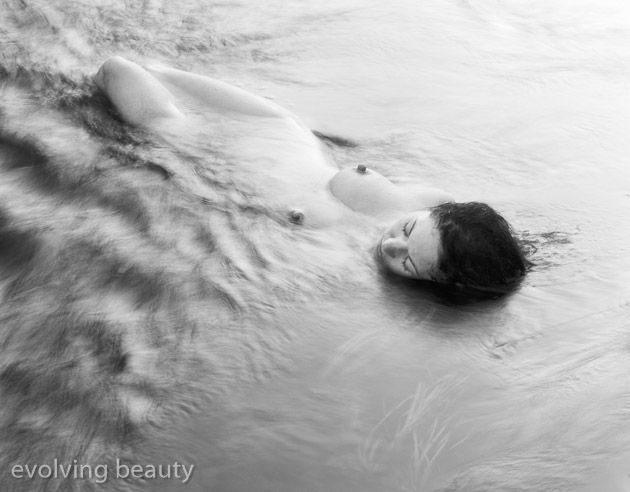
The planned destination for this day was the Mersey River, far inland where it flowed slow and shallow. One of Cassandra's expressed interests when she'd first contacted me was water nudes, so I decided to begin the project there, but rather then working with a space I knew (like Gold River) I opted for the great unknown, and trusted to chance to provide the location. It turns out that Providence was smiling, and the space we found was perfect, with a broad, smooth flowing river between two lush and low banks.
6x9 cm film
We began working in the shallows, playing with the afternoon light on the water and the gentle ripples made by the steady flow of water. Because the river was so shallow, almost all the poses were semi-submerged, with only portions of Cassandra visible above the surface. In the past, most of my water nudes have been with swift flowing water, and have played off the white-water which resulted in interrupting this flow. With the Mersey, however, the pattern of disruption was more like wavelets then white water, with very distinct (and pleasing) results.
4"x5" film
 After about an hour of working, I'd run out of slow-speed film for my 4"x5" camera (necessary for the water-blur effect I was after), and Cassandra was getting pretty chilled, so we abandoned the river, packed up the cameras, and headed back onto the riverbank trail. Fortunately, Cassandra warmed up relatively quickly, and we did a number of land-based poses exploring the soft evening light, as we walked along the river. The best of these was the first successful portrait of the project, with Cassandra gazing directly into the lens, an indistinct freshwater marsh behind. While the main focus of Cassandra, the Nova Scotia Portfolio is the Nude in landscape, like the Victoria Portfolio before it, I planned to include one strong portrait, and being aware of this, planned to constantly return to this approach over the next twelve days.

Surprisingly, once she'd warmed up fully, and had had some food and beverage, Cassandra was willing to take a last stab at some water Nudes before we started back to Feltzen for the night. In our walk down the river, we'd come to a section with a small islet in the middle of the stream, and for the last half-hour, we worked in the stream again, this time using roll film and smaller cameras, to make the most of the final poses.
4"x5" film
Given that Cassandra had never modeled nude before, the first day of work was more then I could have hoped for; three session in as many locations, with strong colour and monochrome work was a strong start on the project I'd envisioned.

July 06, 2001

Cassandra, Nova Scotia III (New Germany, Nova Scotia)

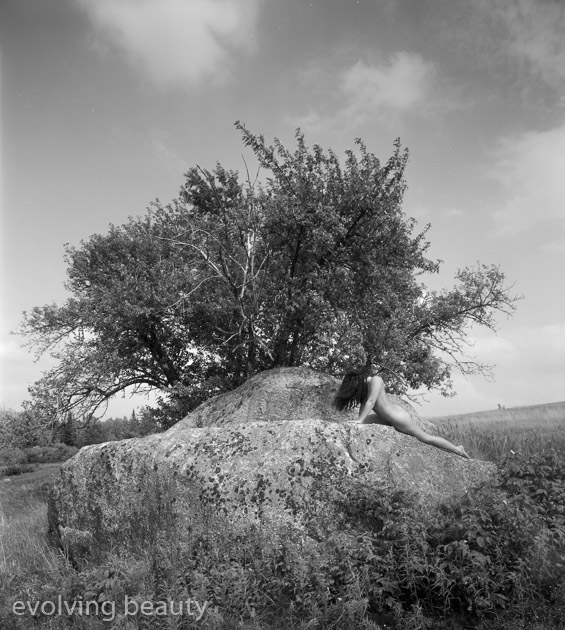
The first outdoor session with Cassandra was actually unplanned; about six weeks earlier, I'd gone along the same route we were taking with R_, and noticed a striking tree and rock in an abandoned farm field by the road, but as we were driving R_ home, there was not time to stop. This trip, however, was of a different nature, so when I spotted the tree again, we pulled off the road, broke out the camera gear, and walked up into the field to work with the space.
8"x10" film
The first, and more serious concern was obvious; the space was visible from the road (in the documentary image you can see the road behind me). The final decision to work with the setting was made after watching the road for several minutes - as a secondary route in rural Nova Scotia, there were very few cars, and those that did pass by were visible and audible before they hit the curve and we came into view.

As it was the rock and tree combined that had first called to me from the setting, it was these two elements which I combined with Cassandra for the first images. The difficulty was that the rock and tree were so massive, and Cassandra so small, relatively speaking, that she was literally dwarfed by them. The only solution was to have her on the very front edge of the rock, and use a wide-angle lens to force the rest of the scene to recede behind her. In the end I made both horizontal and vertical negatives of this setting, but only the vertical turned out as I'd envisioned; the other negative had motion blur in the tree from the strong winds of the early afternoon.
8"x10" film
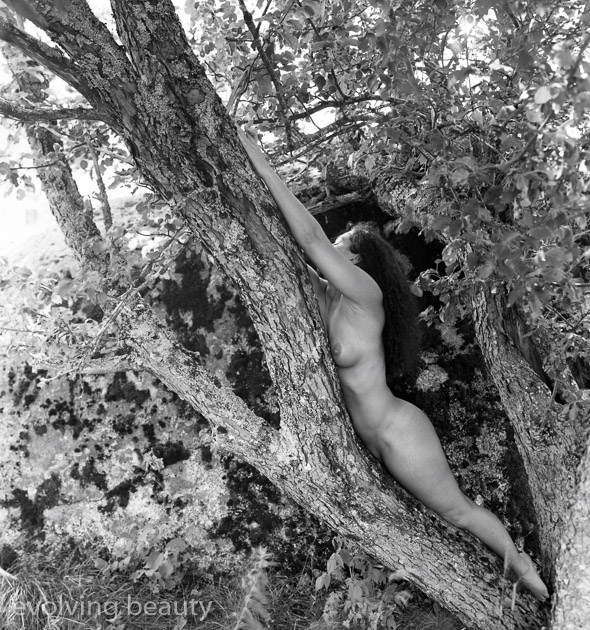
After we finished with the images of the rock and tree as a whole, we moved uphill to the other side of the tree, out of sight of the road. Most of the tree nudes I have done have been in the context of a full forest, where the light is low, and the trees are surrounded by other trees. This solitary tree presented me with an opportunity to work with a model in a tree and not be limited physically in terms of how far back from the model I could be; this also permitted me the freedom to use a longer portrait lens, compressing the tree and rock into a flatter plane, with the lines of the model stretching across it. The resulting image was all I strove for: the strong angular lines of the tree and Cassandra's body carry the eye through the image.

Cassandra, Nova Scotia II (Feltzen South, Nova Scotia)

Though Cassandra was keen and enthusiastic about modeling, she'd never actually modeled nude before. With this in mind, our first session, the morning after her arrival in Nova Scotia, was indoors, to keep it as comfortable and controlled as possible. The house we were staying in had a wonderful cast-iron bathtub that caught my eye as soon as I saw it, and I knew I wanted to work with it. I'd done shower-nudes in the past, but had never worked with a bathtub; the smooth lines of the white bath drew me in and hinted at great possibilities. After a relaxed breakfast, I asked Cassandra if she'd be comfortable starting to model in the bathroom, in the tub. She said yes, and 15 minutes later, we were making images, starting with Cassandra relaxing in the tub.
35mm transparency film
In addition to having no experience with nude modeling, Cassandra was also new to the idea of the view camera, so I began the session by working with a 35mm camera, keeping things as familiar as possible, while she grew comfortable with the process as a whole. This also had the added advantage of permitting me to sketch and explore a new space, and work out what images I wanted to create with the larger 8"x10" camera. More and more, I find myself using smaller cameras to explore possibilities, and when I discover something that has the clarity I seek, I bring out the 8"x10" camera and make an exposure using that.
35mm transparency film
This session was a perfect example, as about ten minutes into it I stood at the head of the tub and framed Cassandra's torso in the curve of the end of the tub. Through the lens, it had a wonderful wholeness to the image, the subtle line of the water along her face, and immediately, I set aside the smaller camera, and brought out the 8"x10". The space was small, and in some way tested my commitment to the bulky camera, but after a rather complex dance between the tripod, camera and myself, I got it in the right position, and managed to frame up the image.

After finishing up with the bathtub, we did some portraits against the window, and then moved, to complete the sessions, into the shower-nook, around the corner. Unlike the shower at my house, which has a skylight, this shower had a long, thin window providing a wonderful light onto Cassandra's body, as it moved under the water. Where before I'd used 1600 ISO slide film for shower nudes at my house, here I was comfortably using 100 ISO film, and reaping all the benefits of smoother grain, and richer colours.
8"x10" film
All in all, the first session with Cassandra went really well; between the black and white tub nude, and a couple of the image of her in the shower, I knew I had some strong successes (though I wouldn't actually see any images for another two weeks or more). While the primary reason for the next 12 days of photography was to produce the outdoor Nudes that will make up the Cassandra Portfolio, I certainly was not going to ignore possible indoor sessions, though the images would not be incorporated in the final Portfolio.

July 05, 2001

Cassandra, Nova Scotia I (Halifax, Nova Scotia)

The Cassandra portfolio's roots go back to 1999, when I produced my first portfolio, Victoria, the Alberta Portfolio. It was remarked by more then one person that I was stepping onto a long road, basing a portfolio on a Canadian Province, as opposed to a model - the obvious extension of the project would be 10 portfolios, one for each Province.
Cassandra had first contacted me about modeling back in 1999, but as she lived in Ontario, a 24 hour drive away, I seriously doubted we'd ever work together. Little did I know. Two years, and one cancellation later, she landed at the Halifax International Airport, and less then 24 hours later, the creation of Cassandra, the Nova Scotia Portfolio began.
While the Victoria Portfolio was born of lucky happenstance, the Cassandra Portfolio was envisioned complete from the first, using the same approach that worked so well for Alberta. As soon as Cassandra had confirmed her flight to Halifax, and the dates, I sent out notices of the Portfolio Prospectus, and began planning for the work. The biggest difficulty with art-making is that it doesn't happen in a vacuum. While it might seem simple enough to decide to do a focused project like the Cassandra Portfolio, the combination of lost income from my two weeks off from my part-time job, and the costs of food and transportation is no small figure to cover. When combined with the film, processing and paper expenses for the portfolio, there'd be no way to carry off such a project without the support of Advanced Patrons. Fortunately, like the Alberta Portfolio of two years earlier, the support for the project was significant, and by the time Cassandra had arrived at the airport, the basics were in place to facilitate a two week project that would result in my second completed portfolio: Cassandra, the Nova Scotia Portfolio.
So, after two months of planning and fund-raising, Cassandra arrived, and the portfolio was underway. While a general schedule had been set, like the Alberta Portfolio, there really wasn't a plan from day to day, with our intent being to take each day one at a time, reacting to the weather, the previous sessions, and the mood of the time.